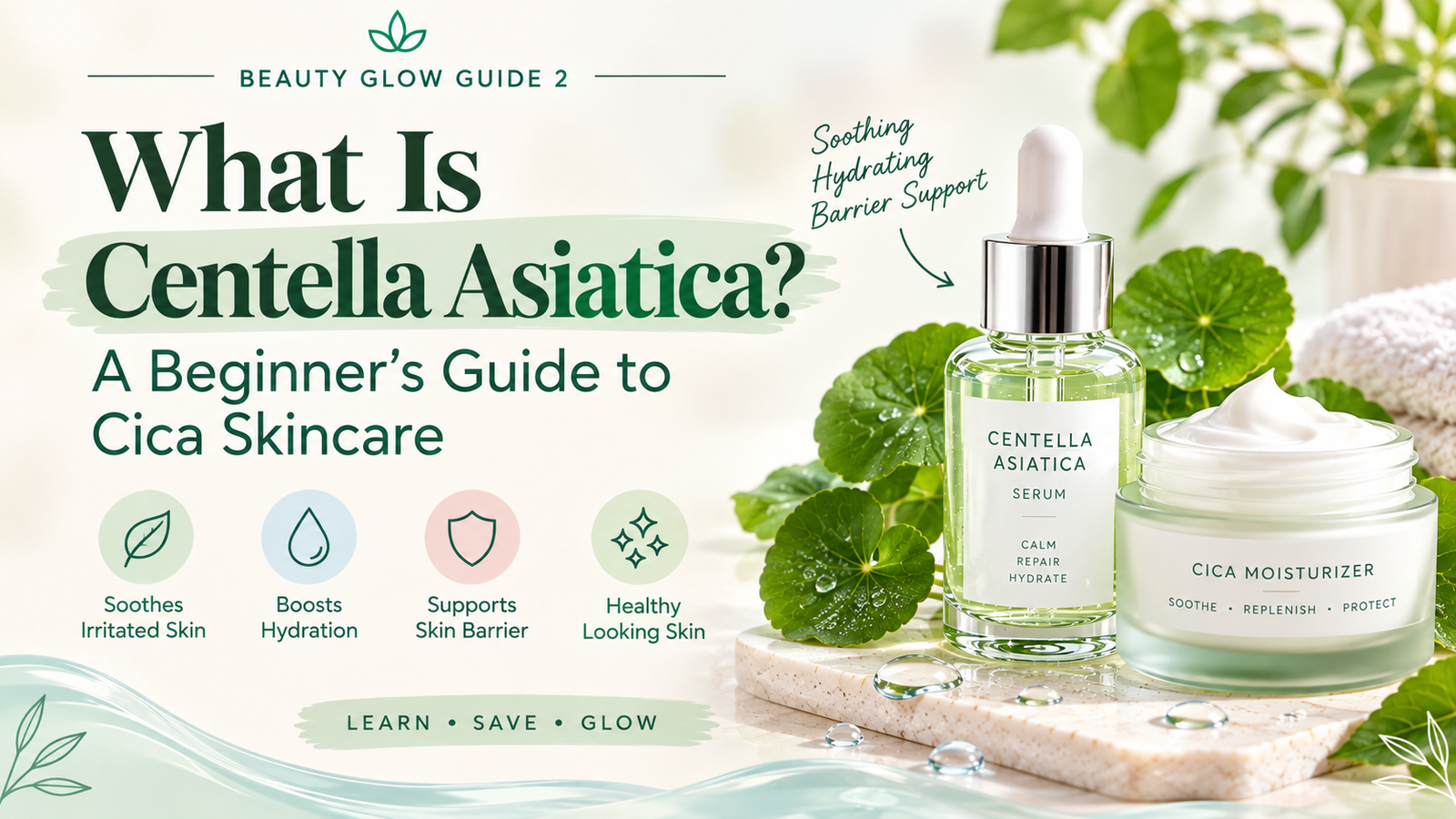
If you’ve spent time looking at Korean skincare products, you’ve probably seen the words Centella asiatica, Cica, or Gotu Kola on product labels.
Centella asiatica is a plant-derived skincare ingredient that has been studied for its potential effects on skin health. Its best-known compounds include asiaticoside, madecassoside, asiatic acid, and madecassic acid.
In modern skincare, Centella is commonly associated with soothing, hydration, skin conditioning, and barrier-focused routines.
But it is important to look beyond marketing claims. Centella products can contain different extracts, concentrations, and combinations of ingredients, so one Cica product is not automatically equivalent to another.
This beginner’s guide explains what Centella asiatica is, what Cica means, how it fits into skincare, and how to use it without making your routine unnecessarily complicated.
Quick Take: What Is Centella Asiatica?
Centella asiatica is a botanical ingredient used in skincare products for skin conditioning and other potential skin-supporting properties.
It is also known as:
- Centella
- Centella asiatica
- Cica
- Gotu Kola
- Tiger Grass
Centella-derived ingredients are used in products such as:
- Serums
- Moisturizers
- Creams
- Toners
- Cleansers
- Masks
- Barrier-focused skincare products
Scientific reviews have examined Centella and its triterpenes for several dermatological applications, although the strength of evidence varies by preparation and use.
What Is Centella Asiatica?
Centella asiatica is a plant traditionally used in several Asian medical systems.
For skincare purposes, the plant is interesting because it contains several compounds known as triterpenes.
The most commonly discussed compounds include:
- Asiaticoside
- Madecassoside
- Asiatic acid
- Madecassic acid
These compounds are among the components researchers have investigated when studying Centella’s effects on skin.
However, a skincare product containing “Centella asiatica extract” does not necessarily contain identical amounts of every compound.
The extraction method and formulation can influence the final product.
What Does Cica Mean in Skincare?
Cica is simply a commonly used skincare name for Centella asiatica.
You may therefore see:
Centella asiatica = Cica
on different skincare products.
The term “Cica” became particularly popular in modern Asian skincare and is now widely used internationally.
A Cica serum and a Centella serum may therefore refer to products based on the same botanical ingredient.
However, always check the ingredient list because the rest of the formula can be very different.
What Are the Potential Benefits of Centella Asiatica?
Centella has been studied for a variety of skin-related effects.
In cosmetic skincare, it is commonly associated with:
- Skin conditioning
- Soothing-focused skincare
- Supporting a healthy-looking skin barrier
- Hydration-focused routines
- Supporting comfortable-feeling skin
- Antioxidant properties of some Centella compounds
Scientific reviews have reported anti-inflammatory and antioxidant activity associated with Centella compounds, while also noting that more controlled clinical research is needed for many specific therapeutic claims.
For everyday skincare, it is therefore more accurate to describe Cica as a supportive skincare ingredient rather than a cure for a particular skin condition.
Centella Asiatica and the Skin Barrier
The skin barrier is the outer protective layer of the skin.
A healthy barrier helps the skin retain moisture and protects against external environmental exposure.
This makes barrier care an important part of a simple skincare routine.
Some research on Centella extracts and their components has investigated effects related to hydration, inflammation, and barrier function.
This is one reason Cica is frequently included in products designed for dry-feeling, stressed-looking, or sensitive-feeling skin.
For a deeper explanation of the barrier itself:
[What Is the Skin Barrier? A Beginner’s Guide to Healthy-Looking Skin]
Centella Asiatica for Sensitive Skin
Centella is often used in skincare marketed toward sensitive skin.
A 2025 prospective study examined a facial cream containing Centella asiatica leaf extract, ceramide NP, and panthenol in people with sensitive skin. The study reported improvements in several measures of sensitivity, hydration, and barrier function over four weeks, although it evaluated a specific multi-ingredient cream, not Centella alone.
That distinction is important.
If a product containing Cica works well for someone, the result cannot automatically be attributed entirely to Centella.
The complete formula matters.
For sensitive-feeling skin, a simple routine can be more useful than continuously adding new products.
Does Centella Asiatica Hydrate Skin?
Centella is not primarily a humectant in the same way as glycerin or hyaluronic acid.
However, Centella-containing formulations have been studied for effects on skin hydration and barrier-related measures.
If hydration is your main goal, ingredients such as:
- Glycerin
- Hyaluronic acid
- Panthenol
- Ceramides
may also be relevant.
Cica can complement these ingredients rather than replacing them.
Learn more:
[What Is Glycerin? A Beginner’s Guide to This Hydrating Skincare Ingredient]
[What Is Hyaluronic Acid? A Beginner’s Guide to Hydrated-Looking Skin]
[What Is Panthenol? A Beginner’s Guide to Pro-Vitamin B5 for Skin]
Centella Asiatica and Panthenol
Centella and panthenol are frequently used together in barrier-focused skincare.
They have different roles.
Centella is a botanical ingredient associated with skin conditioning and soothing-focused formulations.
Panthenol is a pro-vitamin B5 ingredient with humectant and moisturizing properties.
Combining them can make sense in a hydration- and barrier-focused formula.
For more about panthenol:
[What Is Panthenol? A Beginner’s Guide to Pro-Vitamin B5 for Skin]
Centella Asiatica and Ceramides
Ceramides and Centella are also commonly found together.
Ceramides are lipids associated with the skin barrier.
Centella is a botanical extract used for skin conditioning and other cosmetic purposes.
A moisturizer could therefore contain both ingredients while serving multiple aspects of a barrier-focused routine.
For a deeper explanation of ceramides:
[What Are Ceramides? A Beginner’s Guide to Skin Barrier Care]
Centella Asiatica and Niacinamide
Niacinamide and Centella can also appear in the same skincare formula.
Niacinamide is vitamin B3 and is used for several cosmetic purposes, including supporting the appearance of even-looking skin and a healthy skin barrier.
Centella is often included in products focused on soothing and skin conditioning.
Because they have different functions, they do not necessarily need to be treated as competing ingredients.
Read:
[What Is Niacinamide? A Beginner’s Guide to Vitamin B3 for Skin]
Centella Asiatica and Hyaluronic Acid
Hyaluronic acid is primarily associated with hydration.
Centella is a botanical skincare ingredient with different properties.
Using the two together can therefore create a routine that addresses both hydration and skin conditioning.
For example:
Hydrating serum → Cica serum → Moisturizer
But if your Cica product already contains hyaluronic acid, you may not need two separate serums.
Always check the complete ingredient list.
Centella Asiatica and Peptides
Centella can also be combined with peptide skincare.
Peptides are short chains of amino acids used in cosmetic formulations for different purposes.
Centella and peptides therefore represent two different categories of ingredients.
If you’re interested in learning more about peptides:
[What Are Peptides in Skincare? A Beginner’s Guide to Peptide Serums]
Centella Asiatica vs. Cica: What’s the Difference?
There is essentially no ingredient-category distinction between the two names.
Centella asiatica is the botanical name.
Cica is a common skincare name used for Centella-based ingredients and products.
Gotu Kola is another common name for the plant.
The more important question is what form of Centella is actually in the product.
For example, an ingredient list may specify:
- Centella asiatica leaf extract
- Centella asiatica extract
- Centella asiatica leaf water
- Centella-derived compounds
These are not necessarily identical formulations.
What Are Madecassoside and Asiaticoside?
If you’ve looked closely at Cica skincare labels, you may have noticed names such as madecassoside or asiaticoside.
These are naturally occurring compounds associated with Centella asiatica.
Other commonly discussed compounds include:
- Asiatic acid
- Madecassic acid
Researchers have investigated these compounds individually and as components of Centella extracts.
However, seeing one of these names on a label does not by itself tell you how effective the finished product will be.
The complete formulation still matters.
Can You Use Centella Every Day?
Many Centella-containing cosmetic products are designed for regular use.
However, the correct frequency depends on the individual product.
If you’re using a Cica serum or moisturizer, follow the manufacturer’s instructions.
You also don’t need to introduce a Centella product every time your skin feels uncomfortable.
Sometimes the simplest approach is better:
Gentle cleanser → Moisturizer → Sunscreen
Then add a Cica product if it fits your routine.
How to Use Centella Asiatica in Your Routine
The position of Centella depends on the product type.
If You Use a Cica Serum
A simple routine could be:
- Cleanse
- Apply hydrating serum if needed
- Apply Cica serum
- Apply moisturizer
- Apply sunscreen in the morning
If You Use a Cica Moisturizer
Your routine may be:
- Cleanse
- Apply serum
- Apply Cica moisturizer
- Apply sunscreen in the morning
If You Use a Cica Toner
It can generally be used after cleansing and before thicker treatment or moisturizing steps, according to the product directions.
Where Does Cica Go in Skincare Layering?
A useful beginner rule is:
Thin products first → thicker products later.
For example:
Cleanser → Toner → Serum → Moisturizer → Sunscreen
If your Cica product is a serum, it generally belongs around the serum step.
If it is a moisturizer, it belongs later in the routine.
The exact order should always follow the texture and instructions of the individual products.
Can Centella Replace a Moisturizer?
No.
A Cica serum and a moisturizer are not automatically interchangeable.
A serum may provide targeted ingredients, while a moisturizer is formulated to hydrate and condition the skin more broadly.
If your skin needs more moisture, don’t assume that adding another Cica serum will solve the problem.
A moisturizer remains an important part of a basic routine.
Can Centella Replace Sunscreen?
No.
Centella is not a substitute for sunscreen.
If you’re using Cica in the morning, finish your routine with a broad-spectrum sunscreen.
This is particularly important if your broader goal is maintaining healthy-looking skin and minimizing visible effects of environmental exposure.
Is Centella Good for Dry Skin?
Centella can fit comfortably into a routine for dry-feeling skin, particularly when it is combined with moisturizing ingredients.
However, dry skin often benefits from a complete moisturizing system.
Look for formulas that may combine:
- Humectants
- Emollients
- Occlusives
- Ceramides
- Panthenol
- Other conditioning ingredients
Cica can then be one supportive component.
Is Centella Good for Oily Skin?
Centella can also fit into an oily-skin routine.
The key is the product texture, rather than assuming that every Cica product will feel the same.
For oily or combination skin, you might prefer:
- Lightweight Cica serum
- Gel moisturizer
- Lightweight lotion
- Non-heavy hydrating formula
You don’t need to avoid hydration simply because your skin becomes oily.
Centella Asiatica and Glass Skin
Cica can fit into a glass-skin-inspired routine, particularly if your goal is a calm, hydrated, healthy-looking complexion.
But Centella itself does not create glass skin.
A more realistic routine focuses on:
- Gentle cleansing
- Hydration
- Moisturizing
- Barrier support
- Daily sunscreen
Cica can be one ingredient within that routine.
For the complete approach:
[Best Glass Skin Routine: A Simple 4-Step Guide for Healthy, Hydrated Skin]
Common Mistakes When Using Cica Skincare
Mistake 1: Assuming Every Cica Product Is the Same
Different products use different Centella extracts, concentrations, and supporting ingredients.
Always look at the complete formula.
Mistake 2: Treating Cica as a Cure
Centella has been studied for several dermatological applications, but cosmetic skincare should not be presented as a treatment for a medical condition.
Research reviews also note the need for additional well-controlled clinical studies for many applications.
Mistake 3: Adding Too Many Soothing Products
If your routine already contains several barrier-focused products, adding another serum may not provide much additional value.
Mistake 4: Ignoring Irritation From the Whole Formula
Centella itself may not be the source of irritation.
Other ingredients in the product can also cause problems for individual users.
Mistake 5: Expecting Overnight Results
A consistent routine is more useful than constantly switching products.
Is Centella Asiatica Safe in Skincare?
A Cosmetic Ingredient Review assessment examined nine Centella asiatica-derived cosmetic ingredients and concluded that they were safe under the assessed conditions of use and concentration when formulated to be non-sensitizing.
That does not mean every person will tolerate every Cica product.
Individual sensitivity varies, and the complete formula matters.
If a product causes persistent irritation, itching, swelling, or another concerning reaction, stop using it and seek appropriate medical advice.
A Simple Cica Skincare Routine for Beginners
You don’t need a complicated K-beauty routine to use Centella.
Morning
Step 1 — Cleanse
Use a gentle cleanser.
Step 2 — Hydrate
Optional: use a hydrating serum containing ingredients such as glycerin or hyaluronic acid.
Step 3 — Cica Serum
Apply your Centella product according to its directions.
Step 4 — Moisturize
Use a moisturizer suited to your skin.
Step 5 — Sunscreen
Finish with broad-spectrum sunscreen.
Evening
Step 1 — Cleanse
Step 2 — Cica Serum
If you’re using one.
Step 3 — Moisturizer
Keep the routine comfortable and uncomplicated.
Cica in a Barrier-First Routine
Centella fits particularly well with the barrier-first approach used throughout Beauty Glow Guide 2.
Think about your routine as a system:
Cleanse → Hydrate → Condition → Moisturize → Protect
Cica can sit within the conditioning or treatment portion of that routine.
Other ingredients can handle different jobs:
- Glycerin: hydration
- Hyaluronic acid: hydration
- Panthenol: hydration and conditioning
- Ceramides: barrier-focused moisturizing
- Niacinamide: multiple skincare functions
- Peptides: targeted cosmetic skincare
- Cica: botanical skin-conditioning support
You don’t need all of them.
Choose products based on what your routine actually needs.
Frequently Asked Questions
What is Centella asiatica in skincare?
Centella asiatica is a botanical ingredient used in skincare products for skin conditioning and other potential skin-supporting properties.
Is Cica the same as Centella asiatica?
Yes. Cica is a common skincare name for Centella asiatica.
Is Centella good for sensitive skin?
Centella is commonly included in products formulated for sensitive-feeling skin, and some research has examined Centella-containing formulations in sensitive-skin participants. However, the complete formula matters.
Can I use Centella every day?
Many Centella products are designed for regular use. Follow the directions for the specific product.
Can I use Centella with niacinamide?
Yes. They can appear together in skincare formulations and can be part of the same routine.
Can I use Centella with hyaluronic acid?
Yes. They have different roles and can complement a hydration-focused routine.
Can Centella repair the skin barrier?
Centella and its compounds have been studied for effects related to skin-barrier function, hydration, inflammation, and wound healing. However, it is more accurate to say that Centella-containing skincare may support barrier function rather than promise that it will repair a damaged barrier.
Is Centella a hydrating ingredient?
Centella is not primarily a humectant like glycerin or hyaluronic acid, but Centella-containing formulations have been studied for effects on skin hydration and barrier-related measures.
Related Beauty Glow Guide 2 Articles
Continue exploring the Beauty Glow Guide 2 skincare ingredient series:
- [What Is the Skin Barrier? A Beginner’s Guide to Healthy-Looking Skin]
- [What Is Hyaluronic Acid? A Beginner’s Guide to Hydrated-Looking Skin]
- [What Is Niacinamide? A Beginner’s Guide to Vitamin B3 for Skin]
- [What Are Ceramides? A Beginner’s Guide to Skin Barrier Care]
- [What Is Glycerin? A Beginner’s Guide to This Hydrating Skincare Ingredient]
- [What Are Peptides in Skincare? A Beginner’s Guide to Peptide Serums]
- [What Is Panthenol? A Beginner’s Guide to Pro-Vitamin B5 for Skin]
- [Simple Morning Skincare Routine for Beginners: 5 Easy Steps]
- [Best Glass Skin Routine: A Simple 4-Step Guide for Healthy, Hydrated Skin]
Final Thoughts
Centella asiatica, commonly called Cica, is a versatile botanical ingredient that fits naturally into hydration- and barrier-focused skincare routines.
Research has explored Centella and its compounds for skin conditioning, antioxidant and anti-inflammatory activity, wound healing, and other dermatological applications, although evidence varies depending on the preparation and intended use.
For everyday skincare, you don’t need to build an elaborate routine around Cica.
A simple combination of gentle cleansing, hydration, moisturizing, barrier support, and daily sunscreen can provide the foundation, with Centella added as an optional supportive ingredient.
The most important thing is to look at the whole product formula, not just the word “Cica” on the label.
Save This for Later
Centella, Cica, and Gotu Kola can look confusing on skincare labels. Save this guide so you can quickly check what this popular K-beauty ingredient actually does.
Editorial Source Note
This article is based on peer-reviewed reviews and safety literature concerning Centella asiatica and Centella-derived cosmetic ingredients. Evidence differs between whole-plant extracts, isolated compounds, cosmetic formulations, and therapeutic applications, so individual skincare products should not be assumed to reproduce results from clinical or laboratory research.