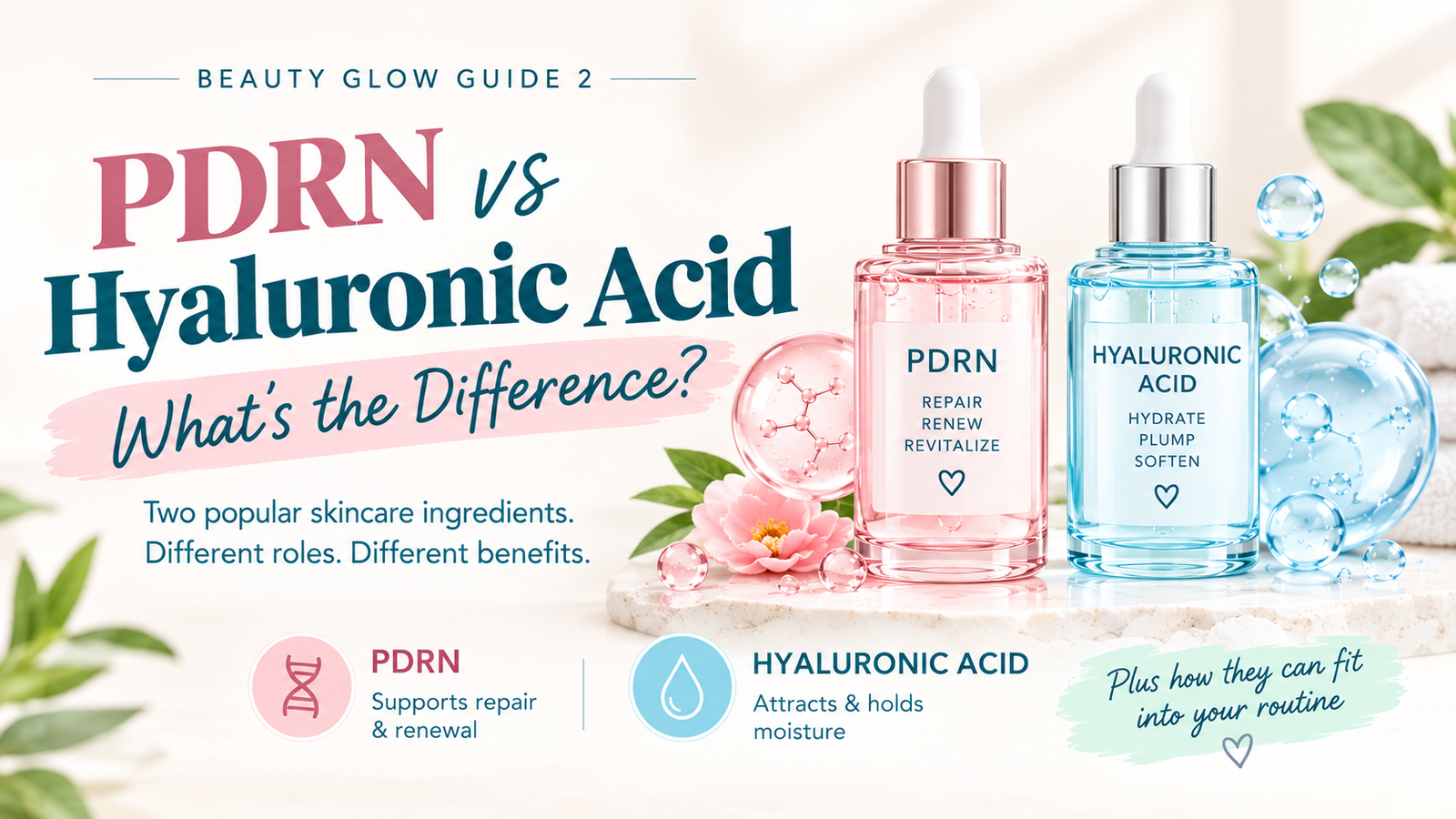
PDRN and hyaluronic acid are two ingredients that frequently appear in modern skincare, especially in hydration-focused and Korean beauty routines. Although they are sometimes discussed together, they have different characteristics and are used for different purposes.
Hyaluronic acid is primarily associated with hydration, while PDRN is a DNA-derived ingredient being studied and used in regenerative and skin-care applications. The evidence and product formulations are not identical, so understanding the difference can help you choose products more thoughtfully.
What Is PDRN?
PDRN stands for polydeoxyribonucleotide, a DNA-derived polymer that has been studied in wound healing, tissue repair, and dermatological applications.
PDRN and related polynucleotide products have attracted attention in aesthetic skincare because research has explored their potential effects on tissue repair, skin quality, and regeneration. However, PDRN and PN are not always used consistently as scientific terms, and products can differ in molecular size, formulation, concentration, and delivery method.
For a more detailed introduction, see our guide:
What Is PDRN in Skincare? A Beginner’s Guide
What is PDRN used for?
PDRN has been investigated for several dermatological applications, including:
- Skin repair and wound healing
- Post-procedure recovery
- Skin rejuvenation
- Changes in skin texture
- Scar-related applications
A 2026 systematic review of seven randomized clinical trials involving 183 participants found potential benefits from PN/PDRN therapies across skin rejuvenation, scar prevention, and wound-healing applications. However, the review also noted small sample sizes, differences between treatment protocols, and other limitations in the available evidence.
That distinction is important when reading claims about topical PDRN skincare. Results from injections, wound-care treatments, or clinical procedures should not automatically be assumed to apply to an ordinary cosmetic serum.
What Is Hyaluronic Acid?
Hyaluronic acid, often shortened to HA, is a naturally occurring molecule found in the body, including the skin.
In skincare, topical hyaluronic acid is commonly used as a humectant, meaning it helps attract and hold water. Reviews of topical HA formulations have found evidence supporting their use for improving skin hydration and moisturization.
You can learn more in our beginner’s guide:
What Is Hyaluronic Acid? A Beginner’s Guide to Hydrated-Looking Skin
What is hyaluronic acid used for?
Hyaluronic acid is commonly included in:
- Hydrating serums
- Moisturizers
- Toners and essences
- Masks
- Eye-area products
Its main skincare role is hydration. Different HA formulations can also behave differently depending on molecular weight and the overall product formula.
PDRN vs Hyaluronic Acid: The Main Difference
The simplest way to understand the difference is to look at their primary roles.
| PDRN | Hyaluronic Acid | |
|---|---|---|
| What it is | DNA-derived polymer | Naturally occurring glycosaminoglycan |
| Main skincare focus | Regenerative/skin-support research | Hydration |
| Common product types | Serums, creams, masks and other formulations | Serums, moisturizers, essences and masks |
| Evidence to consider | Varies significantly by application and formulation | More established for topical hydration |
| Product differences | Molecular size and formulation can vary | Molecular weight and formulation can vary |
| Best understood as | An emerging, research-driven skincare ingredient | A well-established hydration ingredient |
The important point is that PDRN and hyaluronic acid are not interchangeable ingredients.
One should not be treated as simply a stronger version of the other.
PDRN and Skin Hydration
PDRN products are sometimes marketed alongside hydration-focused skincare, but that does not mean PDRN itself should automatically be considered equivalent to a conventional humectant such as hyaluronic acid.
A product containing PDRN may also contain humectants, emollients, moisturizers, or other ingredients that contribute to its overall feel and performance.
This is one reason it is useful to look at the complete ingredient list and formulation, rather than judging a product by one highlighted ingredient.
Hyaluronic Acid and Skin Hydration
Hyaluronic acid has a clearer role when your main goal is adding hydration to a routine.
Topical HA has been studied for its moisturizing and skin-hydration effects, although outcomes can vary depending on the formulation and molecular characteristics of the HA used.
For a simple beginner routine, HA can be used alongside a moisturizer rather than treated as a replacement for one.
Can You Use PDRN and Hyaluronic Acid Together?
Yes, they can appear together in the same skincare routine.
There is no general requirement that you must choose one or the other simply because they are different ingredients.
A simple routine might look like:
- Cleanser
- Hydrating serum or essence
- PDRN product
- Moisturizer
- Sunscreen in the morning
However, the exact order can depend on the texture and instructions of the individual products.
If you are new to skincare layering, our [Simple Morning Skincare Routine for Beginners] can help you understand the basic order of a morning routine.
Simple Morning Skincare Routine for Beginners
What About the Skin Barrier?
Your skin barrier is another reason these ingredients are often discussed together.
Hydration and barrier care are related, but they are not exactly the same thing.
The skin barrier helps limit water loss and protects the outer surface of the skin. A routine that combines appropriate hydration with a moisturizer can help support comfortable, healthy-looking skin.
Learn more:
What Is the Skin Barrier? A Beginner’s Guide to Healthy-Looking Skin
Ceramides are another ingredient commonly associated with barrier-focused skincare. They can be especially useful to understand when comparing hydration with barrier support.
What Are Ceramides? A Beginner’s Guide to Skin Barrier Care
Which One Should You Choose?
There is no universal answer because it depends on what you want from your skincare routine and what the complete product formula contains.
If hydration is your main goal
Hyaluronic acid is the more straightforward ingredient to look for because its role in topical skincare is strongly associated with moisture and hydration.
If you are interested in PDRN skincare
Look at the specific product rather than assuming that every PDRN product works the same way.
Check:
- The complete ingredient list
- The product’s intended use
- The formulation
- How the PDRN is described
- Other active ingredients in the formula
- The manufacturer’s directions
Most importantly, don’t assume that evidence from injectable or clinical PDRN treatments automatically proves the same effect from a cosmetic serum.
PDRN vs Hyaluronic Acid: Quick Takeaway
Think of the two ingredients this way:
Hyaluronic acid → hydration
PDRN → DNA-derived ingredient with research focused on repair and regenerative applications
They can have different roles within the same routine rather than competing directly with each other.
If your routine is already simple and working well, you don’t necessarily need to add both. Start with your primary skincare goal, introduce products gradually, and pay attention to how your skin responds.
Product Pick
#ad Anua PDRN Collagen Glow Facial Serum Spray, 3.38 fl oz, Pack of 2
This product contains PDRN, hyaluronic acid, and collagen and is positioned around hydration and a dewy-looking complexion. The listed size is 3.38 fl oz, with 2 bottles per pack.
Quick Product Box
Anua PDRN Collagen Glow Facial Serum Spray, 3.38 fl oz, Pack of 2
Final Thoughts
PDRN and hyaluronic acid may appear together in modern skincare, but they should not be treated as interchangeable ingredients.
Hyaluronic acid has a well-established role as a hydrating skincare ingredient, while PDRN is an increasingly researched DNA-derived ingredient with evidence spanning medical, aesthetic, and topical applications. Current PDRN/PN research is promising but still limited by differences in formulations, treatment methods, study sizes, and outcome measures.
Understanding that difference makes it easier to evaluate skincare claims without assuming that a popular ingredient automatically delivers the same results in every product.
Save This for Later
Save this guide to your Skincare Ingredients Pinterest board so you can refer back to it when comparing PDRN and hydrating skincare products.
Affiliate Disclosure:
#ad Affiliate link — I may earn a commission from qualifying purchases. As an Amazon Associate I earn from qualifying purchases. Product availability, price and details may change on Amazon. Product sizes, ingredients, packaging, availability, sellers, and delivery information can change. Check current Amazon listing before purchasing.