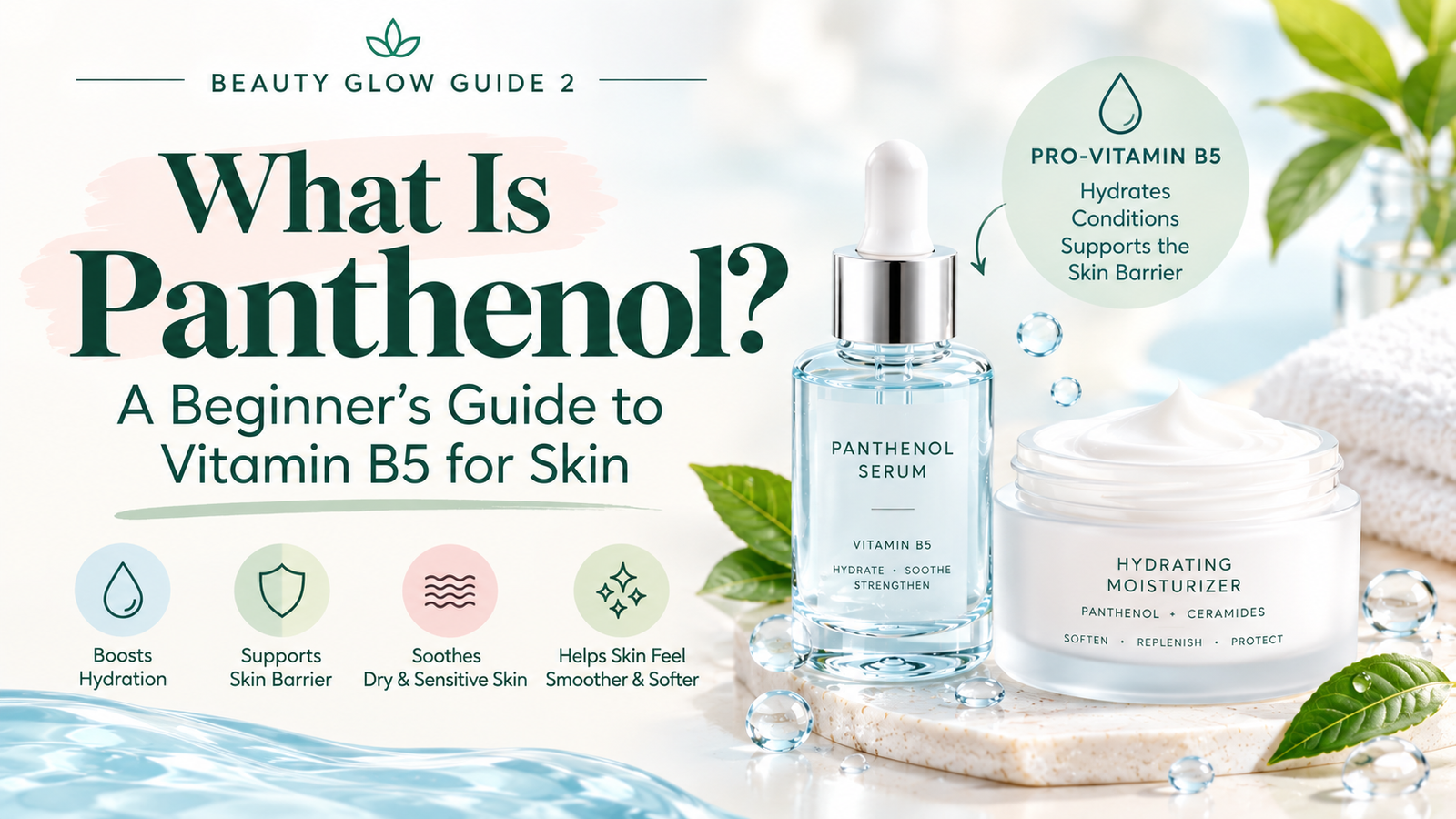
Panthenol is a common ingredient in skincare products designed to moisturize, condition, and support the skin barrier.
You may find it in serums, moisturizers, creams, lotions, cleansers, and products designed for dry or easily irritated skin.
Panthenol is commonly described as a pro-vitamin B5 ingredient. When applied to skin, it can be converted to pantothenic acid, a form of vitamin B5. Research on topical dexpanthenol has found moisturizing and skin-barrier-supporting effects.
If you’re building a simple hydration-focused routine, panthenol is an ingredient worth understanding.
Quick Take: What Is Panthenol?
Panthenol is a provitamin form of vitamin B5 used in skincare as a moisturizing and skin-conditioning ingredient.
It is particularly interesting because research has associated topical dexpanthenol with improved hydration in the outer skin layer and reduced transepidermal water loss in certain formulations.
In everyday skincare terms, panthenol is mainly associated with:
- Hydration
- Moisture retention
- Skin conditioning
- Barrier support
- Comfort for dry-feeling skin
- Supporting a gentle skincare routine
It is not a replacement for every other skincare ingredient, but it can complement a simple routine.
What Is Panthenol Made From?
Panthenol is related to pantothenic acid, or vitamin B5.
The form commonly discussed in topical skincare is dexpanthenol, the biologically active form of panthenol.
Dexpanthenol can be converted in the skin to pantothenic acid and is used in topical formulations because of its moisturizing and skin-conditioning properties.
This is why you may see terms such as:
- Panthenol
- D-panthenol
- Dexpanthenol
- Pro-vitamin B5
- Vitamin B5
on skincare packaging or ingredient lists.
What Does Panthenol Do for Skin?
Panthenol has several properties that make it useful in skincare formulations.
1. Helps Support Skin Hydration
Panthenol has moisturizing and humectant properties.
This means it can help support the water content of the outer skin layer and improve the feel of dry skin.
Studies of topical dexpanthenol-containing formulations have reported improvements in skin hydration.
2. Supports the Skin Barrier
The outer layer of skin helps regulate water loss and protects against environmental exposure.
Research has found that topical dexpanthenol can improve measures associated with skin-barrier function, including transepidermal water loss and hydration in the outer skin layer.
For a deeper explanation of the barrier itself, read What Is the Skin Barrier? A Beginner’s Guide to Healthy-Looking Skin .
3. Helps Condition the Skin
Panthenol is also used as a skin-conditioning ingredient.
In practical terms, products containing panthenol may help leave skin feeling softer and more comfortable.
4. Fits Hydration-Focused Routines
Panthenol can be combined with other familiar hydration ingredients.
For example, a routine could contain panthenol alongside:
- Glycerin
- Hyaluronic acid
- Ceramides
- Niacinamide
- Peptides
The exact combination depends on the individual product formula.
Is Panthenol a Humectant?
Yes. Panthenol has humectant properties, meaning it can help attract and retain water.
This makes it particularly relevant to hydration-focused skincare.
However, panthenol is not simply another name for glycerin or hyaluronic acid. Different humectants have different chemical structures and properties.
For another common humectant, read What Is Glycerin? A Beginner’s Guide to This Hydrating Skincare Ingredient .
Panthenol and the Skin Barrier
The skin barrier helps limit excessive water loss from the skin and provides protection between the body and the external environment.
When the barrier is functioning well, skin can generally retain moisture more effectively.
Topical dexpanthenol has been studied for its ability to support barrier function and hydration. Research has reported improvements in measures such as outer-layer skin hydration and transepidermal water loss.
This makes panthenol a natural fit within a barrier-first skincare approach.
For another barrier-focused ingredient, see What Are Ceramides? A Beginner’s Guide to Skin Barrier Care .
Panthenol for Dry Skin
Panthenol can be useful in a routine designed for dry or dehydrated-feeling skin.
A product containing panthenol may help provide moisture and improve the skin’s overall feel.
However, dry skin often benefits from a combination of moisturizing approaches rather than relying on one ingredient.
A moisturizer may contain:
- Humectants
- Emollients
- Occlusives
- Barrier-supporting lipids
Using these ingredients together can create a more complete moisturizing approach.
Panthenol for Sensitive Skin
Panthenol is frequently included in products marketed toward sensitive or easily irritated skin.
Research has investigated topical dexpanthenol in relation to skin-barrier function and tolerance.
However, panthenol does not automatically make an entire skincare product suitable for every person with sensitive skin.
The complete formula matters. Fragrance, preservatives, acids, retinoids, and other active ingredients can influence how a product feels on individual skin.
If your skin is easily irritated, introduce new products gradually.
Can Panthenol Help a Damaged Skin Barrier?
Panthenol is often discussed in connection with barrier support, and topical dexpanthenol has demonstrated barrier-related benefits in clinical research.
But it is better to say that panthenol supports skin-barrier function rather than claiming that it instantly “repairs” a damaged barrier.
If your skin is irritated, simplifying your routine can be just as important as adding another ingredient.
A simple approach might include:
Gentle cleanser → Hydrating product → Moisturizer → Sunscreen in the morning
You can learn more about barrier-friendly routines in Simple Morning Skincare Routine for Beginners: 5 Easy Steps .
Panthenol vs. Glycerin
Both panthenol and glycerin can support hydration, but they are different ingredients.
| Ingredient | Main skincare role |
|---|---|
| Panthenol | Humectant and skin-conditioning ingredient |
| Glycerin | Humectant that attracts and retains water |
| Hyaluronic acid | Hydrating humectant |
| Ceramides | Barrier-supporting lipids |
You don’t necessarily need to choose between them.
A moisturizer or serum may contain several of these ingredients in the same formula.
Read the full guide: What Is Glycerin? A Beginner’s Guide to This Hydrating Skincare Ingredient .
Panthenol vs. Hyaluronic Acid
Panthenol and hyaluronic acid are both used in hydration-focused skincare, but they are not interchangeable.
Hyaluronic acid is primarily used as a hydrating humectant.
Panthenol provides humectant and skin-conditioning properties and has also been studied for skin-barrier support.
Some skincare products contain both.
For example, a routine using a hyaluronic acid serum, a panthenol-containing moisturizer, and sunscreen can provide several complementary steps without requiring a large number of products.
For a complete guide to hyaluronic acid, read What Is Hyaluronic Acid? A Beginner’s Guide to Hydrated-Looking Skin .
Panthenol and Ceramides
Panthenol and ceramides can work well within the same barrier-focused routine because they have different roles.
Panthenol is a humectant and skin-conditioning ingredient.
Ceramides are lipids naturally associated with the skin barrier and are commonly used in barrier-supporting moisturizers.
A simple combination could be:
Panthenol serum → Ceramide moisturizer
You can also find products that already contain both.
Read What Are Ceramides? A Beginner’s Guide to Skin Barrier Care .
Panthenol and Niacinamide
Panthenol and niacinamide are both common skincare ingredients.
Niacinamide, also known as vitamin B3, is used for several cosmetic purposes, including supporting the appearance of an even-looking complexion and healthy-looking skin.
Panthenol is more closely associated with hydration, conditioning, and barrier support.
They can therefore appear together in a single formula or be used in separate products.
Learn more about niacinamide in What Is Niacinamide? A Beginner’s Guide to Vitamin B3 for Skin .
Panthenol and Peptides
Panthenol can also appear alongside peptides.
Peptides are a broad group of amino-acid chains used in cosmetic formulations for different purposes.
Panthenol contributes moisturizing and conditioning properties.
This means a peptide serum containing panthenol may combine a targeted peptide ingredient with a hydration-supporting ingredient.
For more information, read What Are Peptides in Skincare? A Beginner’s Guide to Peptide Serums .
Can You Use Panthenol Every Day?
Panthenol is commonly used in everyday skincare products.
The appropriate frequency depends on the individual product and its complete formula.
If a moisturizer or serum contains panthenol and is designed for daily use, you can generally follow the manufacturer’s directions.
There is no need to use a separate panthenol product simply because panthenol can be beneficial.
Check the ingredients of your existing moisturizer first. You may already be using it without realizing it.
How to Use Panthenol in a Skincare Routine
Panthenol can appear in several types of skincare products, so its position depends on the product format.
If It Is a Serum
A basic routine could be:
- Cleanser
- Panthenol serum
- Moisturizer
- Sunscreen in the morning
If It Is in a Moisturizer
Use it after your serum or hydrating step.
Cleanser → Serum → Panthenol moisturizer → Sunscreen
If It Is in a Cleanser
Simply use the cleanser according to its directions.
Because it is a rinse-off product, its role in your routine will differ from that of a leave-on serum or cream.
Where Does Panthenol Go in Your Routine?
There isn’t one universal position because panthenol can be included in different product types.
For a leave-on serum, a common order is:
Cleanser → Hydrating or treatment serum → Panthenol product → Moisturizer → SPF
But if your moisturizer already contains panthenol, you don’t need a separate panthenol step.
This is one reason to look at the whole formula, rather than trying to collect individual ingredients.
Can You Use Panthenol With Other Skincare Ingredients?
Panthenol is commonly incorporated into formulas alongside other skincare ingredients.
A hydration-focused routine might include:
- Panthenol
- Glycerin
- Hyaluronic acid
- Ceramides
- Niacinamide
- Peptides
However, more ingredients do not automatically mean a better routine.
If your goal is healthy-looking, hydrated skin, a small number of well-chosen products can be enough.
Panthenol and Glass Skin
Panthenol can fit into a glass-skin-inspired routine because hydration and a smooth-looking skin surface are important parts of a healthy glow.
But panthenol alone does not create glass skin.
A more realistic approach is to focus on:
- Gentle cleansing
- Hydration
- Moisturizing
- Barrier support
- Daily sunscreen
For the complete routine, read Best Glass Skin Routine: A Simple 4-Step Guide for Healthy, Hydrated Skin .
Common Mistakes When Using Panthenol
Mistake 1: Thinking Panthenol Is the Same as Vitamin B5
Panthenol is a pro-vitamin form that can be converted to pantothenic acid.
The terms are related but should not simply be treated as identical ingredients.
Mistake 2: Assuming More Panthenol Is Always Better
The concentration and complete formulation matter.
A product does not automatically become better because it advertises a higher percentage of one ingredient.
Mistake 3: Using Too Many Hydrating Products
Layering multiple serums isn’t necessary for everyone.
If your moisturizer already contains glycerin, panthenol, and ceramides, adding several additional hydrating serums may simply make your routine more complicated.
Mistake 4: Ignoring the Complete Formula
Panthenol may be well tolerated by many users, but the complete product contains other ingredients.
Always consider the entire formula and your individual tolerance.
Mistake 5: Expecting an Instant Barrier Fix
Panthenol can support hydration and barrier function, but skincare is not an overnight process.
A consistent, gentle routine is more important than adding one “hero” ingredient.
Is Panthenol Safe in Skincare?
Panthenol and related ingredients have a history of cosmetic use.
The Cosmetic Ingredient Review Expert Panel has assessed panthenol, pantothenic acid, and several derivatives for use in cosmetics. Individual reactions are still possible, however, and no ingredient guarantees that a finished product will suit everyone.
Allergic contact reactions to panthenol have been reported, although they appear to be uncommon.
If a product causes persistent irritation, itching, swelling, or another concerning reaction, stop using it and seek appropriate medical advice.
A Simple Panthenol Routine for Beginners
You don’t need a complicated routine to use panthenol.
Morning
Step 1 — Cleanser
Use a gentle cleanser appropriate for your skin.
Step 2 — Hydrating Serum
Optional.
Step 3 — Panthenol Product
Use a panthenol serum if your routine includes one.
Step 4 — Moisturizer
Choose a moisturizer suited to your skin’s needs.
Step 5 — Sunscreen
Finish with broad-spectrum sunscreen.
Evening
Step 1 — Cleanser
Step 2 — Panthenol Serum
If you’re using one.
Step 3 — Moisturizer
Keep the routine simple.
Panthenol for a Barrier-First Routine
Panthenol fits especially well with the barrier-first approach used throughout Beauty Glow Guide 2.
Think of the routine as a system rather than a collection of individual ingredients:
Hydrate → Condition → Moisturize → Protect
For example:
Glycerin or Hyaluronic Acid → Panthenol → Ceramide Moisturizer → Sunscreen
The exact products aren’t important here. The goal is to understand what each part of the routine contributes.
Frequently Asked Questions
What Is Panthenol in Skincare?
Panthenol is a pro-vitamin B5 ingredient used in cosmetics for moisturizing, humectant, and skin-conditioning purposes.
Is Panthenol Good for Dry Skin?
Panthenol can support hydration and skin conditioning, making it a useful ingredient in products designed for dry-feeling skin.
Is Panthenol the Same as Vitamin B5?
Panthenol is a provitamin form related to vitamin B5. Dexpanthenol can be converted to pantothenic acid in the skin.
Can I Use Panthenol With Hyaluronic Acid?
Yes. Panthenol and hyaluronic acid have different properties and can be included together in a hydration-focused routine.
Can I Use Panthenol With Niacinamide?
Yes. Panthenol and niacinamide can be used together when appropriate for the complete product formula and your skin.
Can Panthenol Support the Skin Barrier?
Research on topical dexpanthenol has found improvements in measures such as outer-layer skin hydration and transepidermal water loss, supporting its role in barrier-focused skincare.
Can Sensitive Skin Use Panthenol?
Panthenol is widely used in products intended for sensitive or dry skin, but individual tolerance varies and the complete formula matters.
Can I Use Panthenol Every Day?
Many panthenol-containing skincare products are intended for regular use. Follow the directions for your particular product.
Related Beauty Glow Guide 2 Articles
Continue exploring the hydration and skin-barrier series:
- What Is the Skin Barrier? A Beginner’s Guide to Healthy-Looking Skin
- What Is Hyaluronic Acid? A Beginner’s Guide to Hydrated-Looking Skin
- What Is Niacinamide? A Beginner’s Guide to Vitamin B3 for Skin
- What Are Ceramides? A Beginner’s Guide to Skin Barrier Care
- What Is Glycerin? A Beginner’s Guide to This Hydrating Skincare Ingredient
- What Are Peptides in Skincare? A Beginner’s Guide to Peptide Serums
- Simple Morning Skincare Routine for Beginners: 5 Easy Steps
- Best Glass Skin Routine: A Simple 4-Step Guide for Healthy, Hydrated Skin
Final Thoughts
Panthenol is a straightforward skincare ingredient with a useful combination of moisturizing, humectant, and skin-conditioning properties.
Research on topical dexpanthenol also supports its role in maintaining skin hydration and supporting barrier function.
The biggest advantage of panthenol is that it doesn’t need to make your routine complicated.
It can sit comfortably alongside familiar ingredients such as glycerin, hyaluronic acid, ceramides, niacinamide, and peptides.
For a beginner, the goal should not be to collect every trending ingredient.
Instead, build a consistent routine around hydration, moisturization, barrier support, and daily sun protection, then add targeted ingredients when they make sense for your skincare goals.
Save This for Later
Learning skincare ingredients one at a time makes it easier to understand what your products actually do. Save this guide and continue exploring the Beauty Glow Guide 2 skincare ingredient series.
Source Note
This article draws on skincare and dermatology literature about panthenol and topical dexpanthenol, including research on hydration and skin-barrier function. Evidence can vary by formulation, and individual products may not produce identical results.
For further reading, see this PubMed-indexed research on reported allergic contact reactions to panthenol .