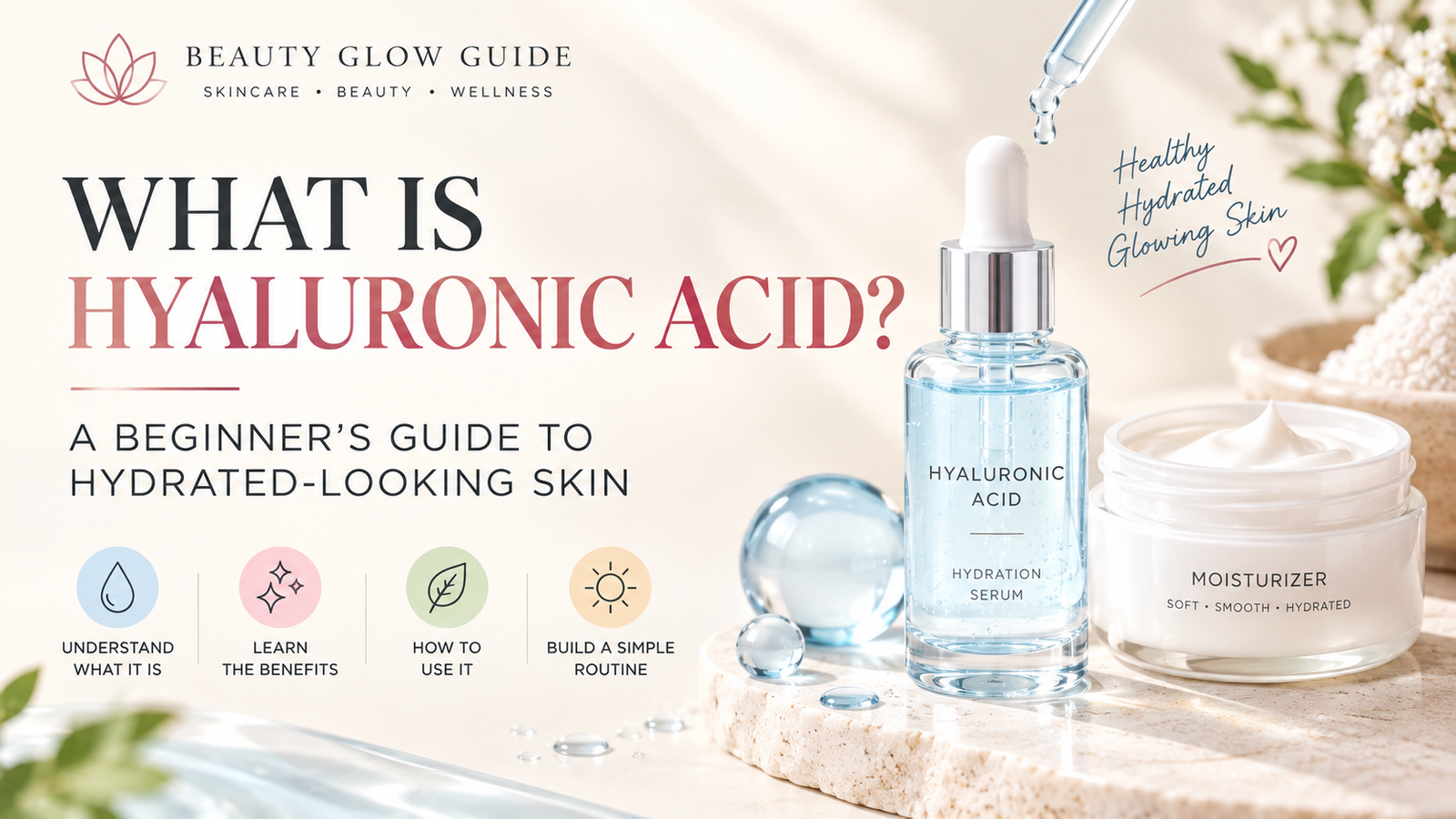
If you have looked at hydrating serums, moisturizers, or K-beauty skincare, you have probably seen hyaluronic acid on the ingredient list.
Hyaluronic acid is a humectant, an ingredient that helps attract and hold water. It is commonly used in hydration-focused skincare products and moisturizers. Despite the word “acid,” it is not an exfoliating acid like glycolic acid or salicylic acid. (American Academy of Dermatology)
In this beginner-friendly guide, you’ll learn what hyaluronic acid does, how to use it, where it fits into a skincare routine, and how it compares with moisturizer and other common skincare ingredients.
What Is Hyaluronic Acid?
Hyaluronic acid is a naturally occurring substance found in the body. In skincare, it is commonly used as a humectant to support skin hydration.
You may find it in:
- Serums
- Moisturizers
- Creams
- Lotions
- Masks
- Other hydration-focused skincare products
The goal is generally simple: help the skin hold onto water so it feels and looks more hydrated.
The American Academy of Dermatology lists hyaluronic acid among ingredients commonly found in moisturizers for dry skin. (American Academy of Dermatology)
Is Hyaluronic Acid an Exfoliating Acid?
No.
This is one of the most common beginner questions.
Hyaluronic acid is not an exfoliating acid. It does not work like alpha hydroxy acids such as glycolic acid or beta hydroxy acids such as salicylic acid.
Instead, hyaluronic acid is primarily used for hydration.
So if you see “acid” in the name, don’t assume that the ingredient will exfoliate your skin.
What Does Hyaluronic Acid Do for Skin?
Hyaluronic acid is mainly used to support hydration.
When skin is well hydrated, it can look:
- Smoother
- Softer
- More comfortable
- Less dry-looking
- More supple
It is important to keep expectations realistic. Hyaluronic acid is a hydration ingredient, not a treatment for every skin concern.
If your main concern is very dry or irritated skin, a broader moisturizing routine may be more useful than relying on a single serum. Moisturizers can combine different types of ingredients to help hydrate skin and reduce water loss. (American Academy of Dermatology)
Why Is Hyaluronic Acid Popular in Skincare?
One reason is its versatility.
Hyaluronic acid can be included in products designed for different skin types and routines. It is especially common in products marketed around hydration and dry-looking skin.
You may also see different forms of hyaluronic acid listed in a product’s ingredient list. The exact formulation varies between products, so it is useful to look at the complete product formula rather than choosing a product based only on the presence of hyaluronic acid.
Hyaluronic Acid vs. Moisturizer
Hyaluronic acid and moisturizer are not necessarily the same thing.
| Hyaluronic Acid | Moisturizer |
|---|---|
| Usually an ingredient or hydration-focused serum | A finished skincare product |
| Commonly used as a humectant | May contain humectants, emollients, and other ingredients |
| Focuses on hydration support | Helps hydrate skin and reduce moisture loss |
| Can be part of a larger routine | Often one of the main routine steps |
A moisturizer may contain hyaluronic acid along with other ingredients.
For example, a moisturizer may combine humectants with emollient or occlusive ingredients that help keep skin comfortable and reduce water loss. (American Academy of Dermatology)
That means you don’t always need a separate hyaluronic acid serum.
Should You Use Hyaluronic Acid If Your Skin Is Dry?
It can be a useful ingredient to consider if your routine is focused on hydration.
However, very dry skin may need more than a single hydrating ingredient.
The American Academy of Dermatology recommends considering moisturizers such as creams or ointments for very dry skin, along with ingredients such as hyaluronic acid and glycerin. (American Academy of Dermatology)
For more guidance, see our article:
How to Build a Simple Hydrating Skincare Routine
How to Use Hyaluronic Acid in a Skincare Routine
A simple routine can look like this:
Morning
- Gentle cleanser
- Hyaluronic acid serum, if you use one
- Moisturizer
- Broad-spectrum sunscreen
Evening
- Cleanser
- Hyaluronic acid serum, if appropriate for your product
- Moisturizer
Your exact routine depends on the products you use and their directions.
For a broader beginner routine, see:
Simple Morning Skincare Routine for Beginners
Should You Apply Hyaluronic Acid to Damp Skin?
Many people use hydrating products on slightly damp skin, but the most important step is to follow the directions for your specific product.
If you use a separate hyaluronic acid serum, moisturizer can be the next step in your routine.
A simple approach is:
Cleanse → Hydrate → Moisturize → Sunscreen in the morning
Moisturizer is particularly important when your skin feels dry because it can help trap water and reduce moisture loss. (American Academy of Dermatology)
What Should You Apply After Hyaluronic Acid?
If hyaluronic acid is being used as a separate serum, a moisturizer is a common next step.
You don’t need to add several different hydrating products simply because they contain different versions of the same type of ingredient.
A simple routine that you can use consistently is often easier to manage than a routine with many overlapping products.
If you’re comparing hydration-focused products, read:
How to Choose the Best Hydrating Serum for Dry-Looking Skin
Hyaluronic Acid and the Skin Barrier
Hydration and skin-barrier care are closely related, but they are not exactly the same thing.
Hyaluronic acid can support hydration, but it is not the same as repairing or replacing the skin barrier.
A barrier-supportive routine may also include a moisturizer containing ingredients such as ceramides and other moisturizing components.
For a deeper explanation, read:
What Is the Skin Barrier? A Beginner’s Guide to Healthy-Looking Skin
You can also learn about ceramides here:
What Are Ceramides? A Beginner’s Guide to Skin Barrier Care
Hyaluronic Acid vs. Glycerin
Hyaluronic acid and glycerin are both commonly used in hydration-focused skincare.
| Ingredient | Main role |
|---|---|
| Hyaluronic acid | Humectant used to support hydration |
| Glycerin | Humectant used to attract and retain water |
They can appear together in the same skincare formula.
Read more:
What Is Glycerin? A Beginner’s Guide to This Hydrating Skincare Ingredient
Hyaluronic Acid vs. Panthenol
Panthenol is another ingredient commonly found in skincare products designed around hydration and skin comfort.
It is different from hyaluronic acid, but the two ingredients can appear together in the same routine or product.
Learn more:
What Is Panthenol? A Beginner’s Guide
Where Does Vichy Minéral 89 Fit?
Some hydration-focused products contain hyaluronic acid as part of a broader formula rather than presenting the ingredient on its own.
For example, Vichy Minéral 89 is a hydration-focused serum that contains hyaluronic acid as part of its formula.
If you’re interested in the difference between a complete branded formula and a simple ingredient-focused approach, read:
Vichy Minéral 89 vs. Hyaluronic Acid Serums: What’s the Difference?
Can You Use Hyaluronic Acid Every Day?
Many hyaluronic acid products are designed for regular use, but the correct frequency depends on the individual product.
Always follow the product’s directions.
If your skin becomes irritated after introducing a new product, stop and reassess the routine rather than adding more products.
Introducing one new product at a time can also make it easier to identify what your skin tolerates.
Can Hyaluronic Acid Be Used With Other Skincare Ingredients?
Hyaluronic acid is commonly included in routines alongside many other skincare ingredients.
For example, a routine may contain:
- Hyaluronic acid
- Glycerin
- Panthenol
- Ceramides
- Niacinamide
- Peptides
- Vitamin C
- Sunscreen
The important point is that the complete routine matters.
More products do not automatically mean better results.
For help organizing products in the correct order, see:
How to Layer Skincare Products
Hyaluronic Acid for Different Skin Types
Dry Skin
Hyaluronic acid can be useful in a hydration-focused routine.
If your skin is very dry, consider pairing hydration-focused products with an appropriate moisturizer rather than relying on a serum alone. (American Academy of Dermatology)
Oily Skin
Oily skin can still become dehydrated.
If you have oily skin, you may prefer a lightweight serum or moisturizer rather than a heavy cream.
Combination Skin
Combination skin may need different textures on different areas of the face.
A lightweight hydration product can be useful when you want hydration without a heavy-feeling routine.
Sensitive Skin
If your skin is sensitive, introduce new products gradually and pay attention to irritation.
Look at the full ingredient list, not just the presence of hyaluronic acid.
If a product causes persistent burning, itching, or irritation, stop using it and consider professional advice.
Common Hyaluronic Acid Mistakes
1. Assuming “acid” means exfoliation
Hyaluronic acid is not an exfoliating acid.
2. Using too many hydrating products
More products aren’t automatically better.
If several products perform similar functions, your routine may become unnecessarily complicated.
3. Skipping moisturizer
A separate hydrating serum does not necessarily replace moisturizer.
Moisturizers can help hydrate the skin and reduce water loss. (American Academy of Dermatology)
4. Ignoring the rest of the routine
Hydration is only one part of skincare.
Cleansing, moisturizing, sun protection, and choosing products appropriate for your skin type all matter.
5. Changing too many products at once
Introducing several new products simultaneously makes it difficult to know which product is responsible if your skin reacts.
A Simple Hydration-Focused Routine
If you’re just starting, you don’t need a complicated routine.
Morning
Cleanser → Hydrating serum → Moisturizer → Sunscreen
Evening
Cleanser → Hydrating serum → Moisturizer
You can adjust this depending on your skin type, product instructions, and other treatments in your routine.
For another beginner-friendly routine, read:
Simple Nighttime Skincare Routine
Quick Guide: Where Does Hyaluronic Acid Fit?
| Routine step | Example |
|---|---|
| 1 | Cleanser |
| 2 | Hydrating serum such as hyaluronic acid |
| 3 | Treatment products, depending on your routine |
| 4 | Moisturizer |
| 5 | Sunscreen in the morning |
The exact order can vary depending on the products you’re using, so check the instructions on each product.
Hyaluronic Acid: Quick Checklist
Before buying a hyaluronic acid product, ask:
- Is my main goal hydration?
- Do I actually need another serum?
- Does the product suit my skin type?
- Have I checked the complete ingredient list?
- Will I use a moisturizer afterward if needed?
- Am I introducing too many new products at once?
- Does the product’s texture work with the rest of my routine?
A simple routine that you can use consistently may be easier to maintain than a complicated routine with many overlapping products. (American Academy of Dermatology)
Final Thoughts
Hyaluronic acid is a popular skincare ingredient because it is commonly used to support hydration.
It is a humectant, not an exfoliating acid, and it can be found in everything from serums to moisturizers.
For beginners, the main takeaway is simple:
Hyaluronic acid can support hydration, but it works as part of a complete skincare routine rather than replacing every other skincare step.
If your routine is focused on dry-looking or dehydrated skin, consider combining appropriate hydration with a moisturizer and daytime sun protection. (American Academy of Dermatology)
Save This for Later
Learning skincare ingredients one at a time can make it easier to understand what your products are actually doing.
Save this guide to your Pinterest board so you can come back to it when comparing hydrating skincare products.
You can also continue exploring Beauty Glow Guide:
- Beginner’s Guide to Skincare Ingredients
- How to Build a Simple Hydrating Skincare Routine
- How to Choose Skincare Products for Your Skin Type
Affiliate Disclosure
#ad Affiliate link — I may earn a commission from qualifying purchases. As an Amazon Associate I earn from qualifying purchases. Product availability, price and details may change on Amazon. Product sizes, ingredients, packaging, availability, sellers, and delivery information can change. Check current Amazon listing before purchasing.
