Tag: hyaluronic acid

  • Beginner’s Guide to Skincare Ingredients: What They Do and Where They Fit

    Reading a skincare label can feel like trying to understand another language.

    You may see ingredients such as hyaluronic acid, niacinamide, glycerin, ceramides, panthenol, peptides, centella asiatica, and snail mucin — but knowing their names does not always tell you what they actually do or where they belong in your routine.

    The good news is that you do not need to memorize every ingredient on a product label.

    A better approach is to understand a few commonly used skincare ingredients, what role they can play in a routine, and what type of product they are usually found in.

    This beginner-friendly guide covers some of the ingredients already discussed on Beauty Glow Guide and explains how they can fit into a simple skincare routine.


    Why Skincare Ingredients Matter

    The ingredient list tells you what is inside a skincare product.

    But one ingredient rarely tells the whole story.

    Two products can contain the same ingredient while having very different textures, concentrations, supporting ingredients, and intended uses.

    That is why it is useful to look at:

    • The complete formula
    • The product type
    • Your skin’s needs
    • How often the product is intended to be used
    • Whether the product fits your existing routine

    Instead of asking which ingredient is universally “best,” think about which ingredients make sense for your particular routine.


    The Main Types of Skincare Ingredients

    For a beginner, it helps to group ingredients according to their general role.

    Hydrating ingredients

    These are commonly included in products designed to increase or support skin hydration.

    Examples include:

    • Hyaluronic acid
    • Glycerin
    • Panthenol

    Barrier-supporting ingredients

    These are commonly found in products designed around skin barrier care.

    Examples include:

    • Ceramides
    • Panthenol

    Skin-conditioning and soothing-focused ingredients

    Examples include:

    • Centella asiatica
    • Panthenol

    Treatment-focused ingredients

    Depending on the product and formulation, ingredients such as niacinamide and retinoids may be used in treatment-focused routines.

    Skin-conditioning ingredients

    Peptides and snail mucin are examples of ingredients frequently used in modern skincare formulas for conditioning, hydration, and other cosmetic purposes.

    The exact role depends on the complete product formula.


    1. Hyaluronic Acid

    Hyaluronic acid is one of the most recognizable ingredients in hydration-focused skincare.

    It is commonly found in:

    • Serums
    • Essences
    • Moisturizers
    • Masks

    If your routine focuses on hydration, you will likely encounter it frequently.

    Read the complete beginner’s guide:

    What Is Hyaluronic Acid? A Beginner’s Guide to Hydrated-Looking Skin

    Where does it fit?

    If you are using a hyaluronic acid serum, it generally fits into the serum step:

    Cleanser → Hyaluronic Acid Serum → Moisturizer → Sunscreen

    The exact application instructions depend on the product.


    2. Glycerin

    Glycerin is another common ingredient in moisturizing skincare products.

    You may find it in:

    • Cleansers
    • Serums
    • Moisturizers
    • Creams
    • Lotions

    One reason glycerin is so common is that it can be incorporated into many different types of formulas.

    You can learn more here:

    What Is Glycerin? A Beginner’s Guide to This Hydrating Skincare Ingredient

    Where does it fit?

    There is no separate “glycerin step.”

    Instead, glycerin is often already part of another product.

    For example:

    Cleanser → Glycerin-containing Serum → Moisturizer → Sunscreen


    3. Panthenol

    Panthenol is another ingredient you may see in hydration and skin-comfort-focused products.

    It can appear in:

    • Serums
    • Essences
    • Creams
    • Moisturizers
    • Other leave-on skincare products

    Read:

    What Is Panthenol? A Beginner’s Guide

    Where does panthenol fit?

    Like glycerin, panthenol does not require its own separate routine step.

    Its position depends on the product containing it.

    A panthenol serum could be used during the serum step, while a panthenol moisturizer would be used during the moisturizing step.


    4. Ceramides

    Ceramides are naturally occurring lipids found in the skin.

    They are frequently used in products focused on moisturizing and supporting the skin barrier.

    You may find them in:

    • Moisturizers
    • Creams
    • Lotions
    • Cleansers
    • Barrier-care products

    Learn more:

    What Are Ceramides? A Beginner’s Guide to Skin Barrier Care

    Where do ceramides fit?

    Ceramides are often found in moisturizers.

    A simple routine could therefore look like:

    Cleanser → Hydrating Serum → Ceramide Moisturizer → Sunscreen

    You do not necessarily need a separate ceramide serum if your moisturizer already contains ceramides.


    5. Niacinamide

    Niacinamide is a form of vitamin B3 commonly used in skincare.

    It can be found in:

    • Serums
    • Moisturizers
    • Toners
    • Other skincare formulas

    Rather than focusing only on the ingredient name, consider the concentration, complete formula, product instructions, and how the product fits into your routine.

    Read the full guide:

    What Is Niacinamide? A Beginner’s Guide to Vitamin B3 for Skin

    Where does niacinamide fit?

    If you use a niacinamide serum:

    Cleanser → Niacinamide Serum → Moisturizer → Sunscreen

    If it is already included in your moisturizer, there is no reason to add another separate niacinamide step simply because the ingredient is popular.


    6. Peptides

    Peptides are another group of ingredients frequently found in skincare products.

    They can appear in:

    • Serums
    • Moisturizers
    • Eye products
    • Other treatment-oriented formulas

    Read:

    What Are Peptides in Skincare? A Beginner’s Guide to Peptide Serums

    Where do peptides fit?

    A peptide serum generally fits into the serum or treatment step.

    For example:

    Cleanser → Peptide Serum → Moisturizer → Sunscreen

    The product’s directions should take priority over a generic routine chart.


    7. Centella Asiatica

    Centella asiatica is often called cica in skincare.

    It is particularly common in K-beauty products and can appear in many different product types.

    You may see centella in:

    • Toners
    • Essences
    • Serums
    • Creams
    • Moisturizers

    Read:

    What Is Centella Asiatica? A Beginner’s Skincare Guide

    Where does centella fit?

    The answer depends on the product.

    A centella toner goes after cleansing.

    A centella serum goes during the serum step.

    A centella moisturizer goes after your serum or treatment.

    The ingredient itself does not determine the routine position.


    8. Snail Mucin

    Snail mucin has become a familiar ingredient in K-beauty skincare.

    It is commonly found in:

    • Essences
    • Serums
    • Creams

    One of the better-known examples is COSRX Advanced Snail 96 Mucin Power Essence.

    Read:

    COSRX Snail Mucin: What It Is, How to Use It & Where It Fits in Your Routine

    Where does snail mucin fit?

    If you are using a snail mucin essence, a simple routine may look like:

    Cleanser → Snail Mucin Essence → Moisturizer → Sunscreen

    If you use other serums, the exact order can depend on the products and their textures.


    9. PDRN

    PDRN is another ingredient you may encounter in newer skincare products.

    It is particularly common in products marketed around hydration, skin conditioning, and skin-recovery-focused routines.

    However, PDRN products can vary significantly in formulation and product type.

    Read:

    What Is PDRN in Skincare? A Beginner’s Guide

    You can also compare it with another well-known hydration ingredient:

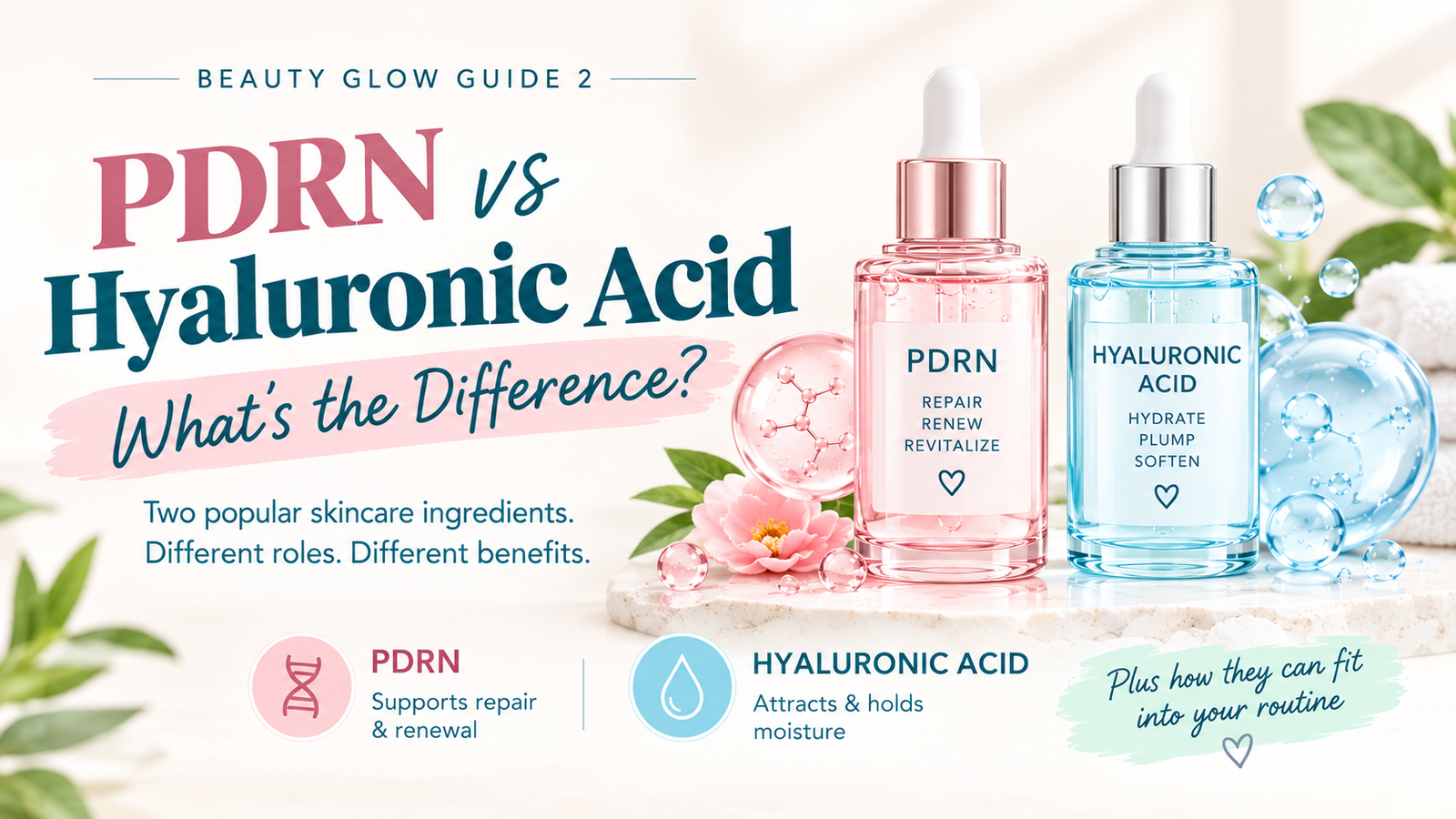
    PDRN vs. Hyaluronic Acid: What’s the Difference?

    Where does PDRN fit?

    There is no universal PDRN step.

    A PDRN serum would generally be used during the serum/treatment portion of a routine.

    A PDRN cream would be used later, during the moisturizing step.

    Always check the instructions for the specific product.


    10. What About Vichy Minéral 89?

    Vichy Minéral 89 is an example of why looking at the complete formula can be more useful than focusing on one ingredient.

    The product is a hydrating serum rather than simply a single-ingredient hyaluronic acid product.

    Read:

    Vichy Minéral 89 vs. Hyaluronic Acid Serums: What’s the Difference?

    You can also read:

    Vichy Minéral 89 Hydrating & Plumping Daily Booster: A Practical Guide

    If you use it as your hydrating serum:

    Cleanser → Vichy Minéral 89 → Moisturizer → Sunscreen


    Ingredients vs. Products: An Important Difference

    This is one of the most useful things for beginners to understand.

    An ingredient is not the same thing as a product.

    For example:

    Hyaluronic acid = ingredient

    Hyaluronic acid serum = product containing that ingredient

    Ceramides = ingredients

    Ceramide moisturizer = product containing those ingredients

    Centella asiatica = ingredient

    Centella essence = product containing that ingredient

    This distinction helps you avoid creating unnecessary routine steps.


    You Don’t Need One Product for Every Ingredient

    Imagine your routine contains:

    • Hyaluronic acid serum
    • Glycerin serum
    • Panthenol serum
    • Ceramide serum
    • Niacinamide serum
    • Peptide serum
    • Centella essence
    • Snail mucin essence

    You could technically have many products, but that does not mean you need all of them.

    In fact, layering too many products can make your routine unnecessarily complicated.

    A simpler approach is to look at the overall formula and decide whether the product serves a purpose you actually need.

    For example, one hydrating serum may already contain several hydration-supporting ingredients.


    A Simple Ingredient-Focused Routine

    You can build a routine without turning every ingredient into a separate step.

    Morning

    Cleanser

    ↓

    Hydrating serum

    ↓

    Moisturizer

    ↓

    Sunscreen

    Night

    Cleanser

    ↓

    Treatment or hydrating serum

    ↓

    Moisturizer

    This is enough for many beginners to start understanding how products fit together.

    For a more detailed explanation, read:

    How to Layer Skincare Products: A Simple Beginner’s Guide


    How Ingredients Fit Into a Hydrating Routine

    If hydration is your main focus, you may come across several complementary ingredients.

    A simple example is:

    Cleanser → Hydrating Serum → Moisturizer → Sunscreen

    Your hydrating serum might contain ingredients such as:

    • Hyaluronic acid
    • Glycerin
    • Panthenol

    Your moisturizer might contain:

    • Ceramides
    • Glycerin
    • Other moisturizing ingredients

    This means you can address several parts of a hydration-focused routine without buying a separate product for every ingredient.

    For more guidance:

    How to Build a Simple Hydrating Skincare Routine

    And:

    How to Choose the Best Hydrating Serum for Dry-Looking Skin


    How Ingredients Relate to Your Skin Barrier

    A healthy-looking skincare routine is not only about adding ingredients.

    It is also about avoiding unnecessary irritation.

    Your skin barrier is part of the outermost layer of your skin and plays an important role in keeping skin protected and hydrated.

    Read:

    What Is the Skin Barrier? A Beginner’s Guide to Healthy-Looking Skin

    When building your routine, consider both what you want to add and what you may need to reduce.


    How to Read a Skincare Product Label

    You do not have to understand every ingredient listed on the package.

    Start with a few practical questions.

    What is the product?

    Is it a:

    • Cleanser?
    • Toner?
    • Essence?
    • Serum?
    • Moisturizer?
    • Sunscreen?

    What is its main purpose?

    Look at the product description and directions.

    What ingredients are highlighted?

    These can tell you what the product is designed around, but remember that the complete formula matters.

    How do you use it?

    Follow the manufacturer’s directions.

    Does it duplicate something you already own?

    If you already have a hydrating serum, buying another product with a very similar purpose may not be necessary.


    Don’t Choose an Ingredient Based Only on a Trend

    Skincare trends can introduce useful ingredients to a wider audience, but popularity alone does not mean you need a particular product.

    Before buying a trending ingredient, ask:

    What am I hoping this product will add to my routine?

    If you cannot answer that question, you may not need it yet.

    A simple routine that you understand is often easier to manage than a collection of products chosen because they are currently popular.


    Common Beginner Mistakes With Skincare Ingredients

    1. Treating every ingredient as a separate step

    You don’t need a separate serum for every ingredient.

    2. Buying products before identifying your goal

    Start with what you want your routine to accomplish.

    3. Introducing several new products simultaneously

    If irritation occurs, it becomes harder to identify the cause.

    4. Ignoring product texture

    Two products with similar ingredients can feel very different on the skin.

    5. Forgetting sunscreen

    A good morning routine should finish with sun protection.

    6. Assuming stronger means better

    A more complicated or concentrated formula is not automatically more appropriate for your skin.

    7. Replacing your entire routine whenever a new ingredient becomes popular

    Give your existing routine a chance to work before constantly changing it.


    A Beginner’s Ingredient Cheat Sheet

    IngredientCommon roleCommon product types
    Hyaluronic acidHydration-focusedSerums, essences, moisturizers
    GlycerinMoisturizing/hydrationCleansers, serums, creams
    PanthenolHydration and skin comfortSerums, essences, moisturizers
    CeramidesBarrier-focused moisturizingCreams, lotions, moisturizers
    NiacinamideMultifunctional skincare ingredientSerums, toners, moisturizers
    PeptidesSkin-conditioning/treatment-focusedSerums, creams
    Centella asiaticaSkin-comfort-focusedToners, essences, serums, creams
    Snail mucinHydration/skin-conditioningEssences, serums, creams
    PDRNProduct-dependent skincare ingredientSerums, creams, other leave-on products

    The table is a starting point, not a complete description of everything each ingredient can do. The complete formula and product instructions matter.


    A Simple Way to Build Your Routine

    Instead of starting with ingredients, start with steps.

    Step 1: Cleanse

    Choose a cleanser that feels comfortable and suits your skin.

    Step 2: Hydrate or Treat

    Choose one serum or essence based on your main goal.

    Step 3: Moisturize

    Use a moisturizer appropriate for your skin and preferred texture.

    Step 4: Protect

    Use sunscreen during the day.

    Then, if needed, add additional products gradually.

    This approach prevents your routine from becoming an ingredient checklist.


    Final Thoughts

    Skincare ingredients can look complicated, but you don’t need to become an expert in every ingredient to build a useful routine.

    Start with the basics.

    Understand your skin.

    Choose products according to a clear purpose.

    Look at the complete formula rather than one ingredient alone.

    And remember that ingredients such as hyaluronic acid, glycerin, panthenol, ceramides, niacinamide, peptides, centella asiatica, snail mucin, and PDRN can appear in very different product types.

    The most useful question is not simply:

    “What is the best skincare ingredient?”

    Instead, ask:

    “What does my routine need, and which product can fill that role?”

    That simple change can make skincare shopping much easier.


    Save This for Later

    Save this guide as a quick reference when you’re reading skincare labels or shopping for new products.

    Ingredient → Purpose → Product type → Routine step

    For more practical skincare education, explore the Skincare & K-Beauty category.


    Affiliate Disclosure

    #ad Affiliate link — I may earn a commission from qualifying purchases. As an Amazon Associate I earn from qualifying purchases. Product availability, price and details may change on Amazon. Product sizes, ingredients, packaging, availability, sellers, and delivery information can change. Check current Amazon listing before purchasing.


  • How to Choose Skincare Products for Your Skin Type: A Simple Beginner’s Guide

    Choosing skincare products can feel overwhelming when every bottle seems to promise something different.

    One product says it is made for dry skin. Another is designed for oily skin. Others focus on hydration, the skin barrier, redness, pores, or signs of aging.

    The easiest way to simplify your choices is to start with your skin type, your main skin concern, and the role of each product in your routine.

    You do not need a shelf full of products to build a useful skincare routine. A few well-chosen products can be enough.

    This guide explains how to understand your skin type, what to look for in skincare products, and how ingredients such as hyaluronic acid, glycerin, niacinamide, panthenol, ceramides, peptides, and centella fit into a simple routine.


    Why Your Skin Type Matters

    Your skin type can help you choose suitable product textures and decide what to prioritize.

    The common categories are:

    • Dry skin
    • Oily skin
    • Combination skin
    • Normal skin
    • Sensitive or easily irritated skin

    Skin can also change with weather, age, hormones, products, and other factors.

    That means your skin type is not necessarily a permanent label.

    For example, someone may experience more dryness during colder weather and more oiliness during hot or humid weather.

    Instead of trying to find a perfect category, pay attention to how your skin behaves.


    How to Identify Your Skin Type

    Start with clean skin.

    After cleansing, leave your skin without skincare for a short period and observe how it feels.

    Skin that feels tight or dry

    Your skin may lean toward dry.

    You may notice that your skin feels uncomfortable after cleansing or looks dry or flaky.

    Skin that becomes noticeably shiny

    Your skin may lean toward oily.

    Oiliness can be especially noticeable around the forehead, nose, and cheeks.

    An oily T-zone with drier cheeks

    Your skin may be combination.

    The forehead and nose may become oily while other areas feel more comfortable or dry.

    Skin that feels fairly balanced

    Your skin may be closer to normal.

    However, even normal skin can become dry, oily, or irritated depending on circumstances.

    Skin that reacts easily

    If your skin frequently feels uncomfortable, stings, burns, or becomes irritated by products, you may need a particularly simple routine.

    In that situation, introducing fewer products at a time can make it easier to identify what your skin tolerates.


    Dry Skin: What Should You Look For?

    If your skin tends to feel dry or tight, focus on gentle cleansing, hydration, and moisturizing.

    Look for products described as:

    • Hydrating
    • Moisturizing
    • Gentle
    • Fragrance-free, if fragrance is a concern for you
    • Cream or lotion textures, depending on preference

    Ingredients commonly found in hydration-focused products include:

    • Hyaluronic acid
    • Glycerin
    • Panthenol
    • Ceramides

    You can learn more about hydration ingredients in:

    What Is Hyaluronic Acid? A Beginner’s Guide to Hydrated-Looking Skin

    You can also read:

    What Is Glycerin? A Beginner’s Guide to This Hydrating Skincare Ingredient

    And:

    What Is Panthenol? A Beginner’s Guide


    Oily Skin: What Should You Look For?

    If your skin becomes oily easily, you may prefer lightweight products.

    Look for textures such as:

    • Gel
    • Lightweight lotion
    • Lightweight serum
    • Non-greasy formulas

    However, oily skin still needs hydration.

    Avoid assuming that oily skin means you should remove every moisturizing step from your routine.

    A simple routine can still include:

    Cleanser → Lightweight serum → Moisturizer → Sunscreen

    The important thing is finding textures that feel comfortable on your skin.


    Combination Skin: Keep Things Balanced

    Combination skin can require a little more flexibility.

    You may find that one product feels comfortable on your cheeks but too heavy around your T-zone.

    Instead of creating completely separate routines, start with a simple routine and adjust textures when necessary.

    For example:

    Morning

    Cleanser → Lightweight hydrating serum → Moisturizer → Sunscreen

    If some areas need more moisture, you can apply a richer moisturizer to those areas rather than automatically using a heavy product everywhere.


    Sensitive or Easily Irritated Skin

    If your skin is easily irritated, simplicity can be helpful.

    Start with:

    1. Gentle cleanser
    2. Simple moisturizer
    3. Sunscreen during the day

    Once your basic routine feels comfortable, you can consider adding one additional product at a time.

    This approach makes it easier to identify which product may be causing a reaction.

    Avoid introducing several new active ingredients simultaneously.

    If you experience persistent burning, significant irritation, swelling, or another concerning reaction, stop the suspected product and consider speaking with a healthcare professional.


    The Skin Barrier Matters for Every Skin Type

    Your skin type is only one part of choosing skincare.

    The condition of your skin barrier also matters.

    The skin barrier helps protect the outer layer of the skin and helps maintain its moisture balance.

    A routine that is too aggressive can leave skin feeling uncomfortable.

    Learn more here:

    What Is the Skin Barrier? A Beginner’s Guide to Healthy-Looking Skin


    What Are Ceramides and Why Are They Used?

    Ceramides are lipids naturally found in the skin.

    They are commonly included in moisturizers and products designed around barrier care.

    If you are looking for a moisturizer for dry-looking or barrier-focused skincare, ceramides may be an ingredient worth recognizing on a product label.

    Read:

    What Are Ceramides? A Beginner’s Guide to Skin Barrier Care


    What Should You Look for in a Hydrating Serum?

    If hydration is your main concern, you do not necessarily need an expensive or complicated serum.

    Look for ingredients commonly used in hydration-focused formulas, such as:

    Hyaluronic Acid

    Hyaluronic acid is widely used in hydrating skincare products.

    Glycerin

    Glycerin is another common moisturizing ingredient found in many skincare formulas.

    Panthenol

    Panthenol is commonly used in products designed around hydration and skin comfort.

    Snail Mucin

    Snail mucin is commonly found in K-beauty essences and serums.

    You can read:

    COSRX Snail Mucin: What It Is, How to Use It & Where It Fits in Your Routine


    How to Choose a Serum Without Overcomplicating Your Routine

    Before buying a serum, ask three simple questions:

    1. What am I trying to address?

    Is your main priority:

    • Hydration?
    • Oiliness?
    • Uneven-looking skin?
    • Skin comfort?
    • A particular treatment recommended by a professional?

    2. What ingredients does the product contain?

    Look beyond the front label and check the ingredient list.

    3. Where will it fit into my routine?

    A serum is generally used after cleansing and before moisturizer.

    For a complete explanation:

    How to Layer Skincare Products: A Simple Beginner’s Guide


    What About Niacinamide?

    Niacinamide, also known as vitamin B3, is a common skincare ingredient.

    It appears in many different products, including serums and moisturizers.

    Rather than choosing a product simply because it contains niacinamide, consider the complete formula and whether it fits your routine.

    Learn more:

    What Is Niacinamide? A Beginner’s Guide to Vitamin B3 for Skin


    What About Peptides?

    Peptides are another ingredient commonly found in skincare products.

    You may see them in:

    • Serums
    • Moisturizers
    • Eye products
    • Anti-aging-focused formulas

    If you are considering a peptide product, look at the complete formula rather than treating the word “peptide” as a guarantee of a particular result.

    Read:

    What Are Peptides in Skincare? A Beginner’s Guide to Peptide Serums


    What About Centella Asiatica?

    Centella asiatica, also known as cica, appears in many K-beauty products.

    Depending on the formula, it may be found in:

    • Toners
    • Essences
    • Serums
    • Creams
    • Moisturizers

    The product format determines where it belongs in your routine.

    Read:

    What Is Centella Asiatica? A Beginner’s Skincare Guide


    How to Choose a Moisturizer

    Moisturizer is one of the easiest products to choose based on texture.

    Dry-looking skin

    You may prefer a richer cream or lotion.

    Oily-looking skin

    A lightweight gel or lotion may feel more comfortable.

    Combination skin

    You may prefer a medium-weight moisturizer or adjust the amount used in different areas.

    Easily irritated skin

    A simple formula with fewer unnecessary extras may be easier to tolerate.

    Remember that the same texture does not work equally well for everyone.


    How to Choose Sunscreen

    For daytime skincare, sunscreen is an important final step.

    When choosing sunscreen, consider:

    • Broad-spectrum protection
    • SPF level
    • Texture
    • Your skin’s comfort
    • Whether it works well under makeup
    • Whether you will realistically use enough of it

    The American Academy of Dermatology recommends broad-spectrum sunscreen with SPF 30 or higher for sun protection.

    Your sunscreen should be the final skincare step before makeup.


    Don’t Choose Products Only Because They Are Trending

    A popular product is not automatically appropriate for your skin.

    Before buying a trending product, ask:

    Does it address something I actually want to address?

    Will it fit into my current routine?

    Do I already own a product that performs a similar role?

    Can my skin tolerate the ingredients?

    This approach can help prevent a routine from becoming unnecessarily complicated.


    Don’t Buy Five New Products at Once

    If you want to improve your skincare routine, changing everything simultaneously can make the process difficult.

    Suppose you introduce:

    • A new cleanser
    • A new toner
    • A new serum
    • A new moisturizer
    • A new exfoliant

    and your skin becomes irritated.

    It can be difficult to know which product caused the problem.

    Instead, introducing products gradually gives you more information about how your skin responds.


    A Simple Beginner Shopping List

    If you are starting from scratch, you can keep your shopping list short.

    1. Gentle cleanser

    Choose something appropriate for your skin and comfortable enough for regular use.

    2. Moisturizer

    Choose a texture that suits your skin.

    3. Sunscreen

    Choose broad-spectrum SPF 30 or higher for daytime use.

    4. Optional hydrating serum

    Consider this if you want an additional hydration step.

    5. Optional treatment

    Add a treatment only when you have a clear reason for using it.

    You do not need all five immediately.


    A Simple Routine for Dry-Looking Skin

    Morning

    1. Gentle cleanser
    2. Hydrating serum
    3. Moisturizer
    4. Sunscreen

    Night

    1. Gentle cleanser
    2. Hydrating serum
    3. Moisturizer

    Possible hydration-focused ingredients include hyaluronic acid, glycerin, panthenol, and ceramides.

    For more ideas, read:

    How to Build a Simple Hydrating Skincare Routine

    And:

    How to Choose the Best Hydrating Serum for Dry-Looking Skin


    A Simple Routine for Oily-Looking Skin

    Morning

    1. Gentle cleanser
    2. Lightweight serum, if desired
    3. Lightweight moisturizer
    4. Sunscreen

    Night

    1. Cleanser
    2. Treatment or serum
    3. Lightweight moisturizer

    The goal is not to eliminate moisture from the routine.

    Instead, choose products that feel comfortable and avoid unnecessary layers.


    A Simple Routine for Combination Skin

    Morning

    Cleanser → Lightweight hydrating serum → Moisturizer → Sunscreen

    Night

    Cleanser → Serum or treatment → Moisturizer

    You can adjust the amount or texture of moisturizer depending on different areas of your face.


    A Simple Routine for Beginners

    If you are still unsure where to start, use this basic routine:

    Morning

    Cleanser → Moisturizer → Sunscreen

    Night

    Cleanser → Moisturizer

    After your skin is comfortable with these basics, you can consider adding a hydrating serum or another targeted product.

    This keeps the routine easy to understand.


    How to Choose Between Similar Products

    Sometimes you will find several products that appear to do the same thing.

    For example, you may see:

    • A hyaluronic acid serum
    • A multi-ingredient hydrating serum
    • A snail mucin essence
    • A peptide serum
    • A PDRN serum

    Instead of asking which ingredient is universally “best,” ask:

    What does the complete formula offer, how does it feel on my skin, and where does it fit into my routine?

    For example, Vichy Minéral 89 is a complete branded hydrating formula rather than simply a bottle of one isolated ingredient.

    Read:

    Vichy Minéral 89 vs. Hyaluronic Acid Serums: What’s the Difference?


    Skincare Product Checklist Before Buying

    Before adding a product to your cart, check:

    ✓ What is my main skincare goal?

    ✓ What skin type is the product designed for?

    ✓ What is the product’s texture?

    ✓ What are the main ingredients?

    ✓ Where does it fit in my routine?

    ✓ Am I already using something similar?

    ✓ Am I introducing too many new products at once?

    ✓ Can I realistically use it consistently?

    ✓ Have I checked the current product directions and ingredient list?

    Product formulas, packaging, availability, and instructions can change, so check the current product information before purchasing.


    Final Thoughts

    Choosing skincare products becomes much easier when you stop trying to build the perfect routine and focus on what your skin actually needs.

    Start with the basics:

    Cleanser → Moisturizer → Sunscreen

    Then add products based on a specific purpose.

    If hydration is your priority, explore ingredients such as hyaluronic acid, glycerin, panthenol, and ceramides.

    If you are interested in K-beauty, ingredients such as snail mucin and centella asiatica can be explored as part of a simple routine.

    And if you are considering treatment-focused products, introduce them gradually and follow their directions.

    A thoughtful skincare routine does not have to be complicated. The best starting point is a routine you understand and can use consistently.


    Save This for Later

    Save this guide as a quick reference when you are shopping for skincare products.

    Know your skin → Choose your goal → Check the ingredients → Consider the texture → Build a simple routine.

    For more practical skincare guides, visit the Skincare & K-Beauty category.


    Affiliate Disclosure

    #ad Affiliate link — I may earn a commission from qualifying purchases. As an Amazon Associate I earn from qualifying purchases. Product availability, price and details may change on Amazon. Product sizes, ingredients, packaging, availability, sellers, and delivery information can change. Check current Amazon listing before purchasing.


  • How to Layer Skincare Products: A Simple Beginner’s Guide

    Skincare can become confusing when you have several products on your shelf. Should you apply hyaluronic acid before niacinamide? Does moisturizer go before sunscreen? Where does snail mucin fit?

    The good news is that you usually do not need a complicated routine. A simple approach is to cleanse first, apply treatments and serums, moisturize, and finish your morning routine with sunscreen. The American Academy of Dermatology recommends cleansing first, followed by medication or treatment, then moisturizer and/or sunscreen, with makeup applied afterward if desired. (American Academy of Dermatology)

    This guide explains how to layer common skincare products and where some of the ingredients already covered on Beauty Glow Guide fit into a beginner-friendly routine.

    What Does Skincare Layering Mean?

    Skincare layering simply means applying your products in an order that makes sense for your routine.

    A useful basic framework is:

    Cleanse → Treat/Hydrate → Moisturize → Protect

    You can add or remove steps depending on your skin, the products you use, and whether you are following a treatment recommended by a healthcare professional.

    More products are not automatically better. The AAD notes that using too many products can irritate the skin, particularly when several potentially irritating treatments are introduced together. (American Academy of Dermatology)

    For beginners, starting with fewer products can make it easier to understand what your skin tolerates.


    The Basic Skincare Layering Order

    A simple morning routine can look like this:

    1. Cleanser
    2. Toner or essence, if you use one
    3. Hydrating or treatment serum
    4. Moisturizer
    5. Sunscreen
    6. Makeup, if desired

    At night, the basic order is similar, but sunscreen is removed from the routine:

    1. Cleanser
    2. Toner or essence, if used
    3. Treatment or serum
    4. Moisturizer

    The exact order can change when you are using a prescription treatment or a product with specific application instructions. Dermatologists generally recommend following the instructions for the particular treatment. (American Academy of Dermatology)


    Step 1: Start With Cleanser

    Cleanser goes first because you want to remove makeup, sunscreen, excess oil, sweat, and everyday buildup before applying leave-on products.

    The American Academy of Dermatology recommends using a gentle, non-abrasive cleanser, applying it with your fingertips, rinsing with lukewarm water, and gently patting the skin dry. (American Academy of Dermatology)

    You can read more about creating a basic morning routine in:

    Simple Morning Skincare Routine for Beginners: 5 Easy Steps

    A simple rule

    Clean skin first, leave-on products afterward.

    You do not need to scrub aggressively to prepare your skin for the next step. Scrubbing can irritate the skin. (American Academy of Dermatology)


    Step 2: Toner or Essence, If You Use One

    Toner or essence is optional.

    Some people like these products because they add hydration or provide another lightweight step before serums. Others prefer to keep their routine shorter.

    If you use one, apply it after cleansing and before your leave-on treatments.

    You do not need a toner simply because skincare routines online often include one.

    The goal is to build a routine that you can use consistently without unnecessarily adding products.


    Step 3: Apply Your Hydrating or Treatment Serum

    This is where many of your skincare ingredients can fit.

    Depending on the product, this step may include ingredients such as:

    • Hyaluronic acid
    • Glycerin
    • Panthenol
    • Niacinamide
    • Peptides
    • Centella asiatica
    • Snail mucin
    • Other targeted treatments

    For example, hyaluronic acid is commonly used in hydration-focused routines.

    You can also learn about glycerin and panthenol, which are both relevant to hydration-focused skincare.

    What about niacinamide?

    Niacinamide can be used as a treatment or serum step depending on the particular product.

    Read more:

    What Is Niacinamide? A Beginner’s Guide to Vitamin B3 for Skin

    What about peptides?

    Peptide products generally fit into the serum or treatment portion of a routine.

    What Are Peptides in Skincare? A Beginner’s Guide to Peptide Serums


    Step 4: Where Does Snail Mucin Go?

    If you use a product such as COSRX Advanced Snail 96 Mucin Power Essence, it can fit after cleansing and before moisturizer.

    For example:

    Cleanser → Snail Mucin → Moisturizer

    If you use other serums, the exact order can depend on the products’ instructions and textures.

    You can read the complete guide here:

    COSRX Snail Mucin: What It Is, How to Use It & Where It Fits in Your Routine


    Step 5: Apply Moisturizer

    Moisturizer comes after your serum or treatment steps in a simple routine.

    Its job is to help moisturize the skin and reduce water loss. Moisturizers come in different forms, including lotions, gels, creams, and ointments, so the best texture depends partly on your skin and preferences. (American Academy of Dermatology)

    For dry-looking skin, applying moisturizer while the skin is still slightly damp can help trap water. (American Academy of Dermatology)

    If you’re building a hydration-focused routine, see:

    How to Build a Simple Hydrating Skincare Routine

    You can also learn more about choosing a hydrating serum:

    How to Choose the Best Hydrating Serum for Dry-Looking Skin


    Step 6: Finish Your Morning Routine With Sunscreen

    Sunscreen should be the final skincare step in your morning routine, before makeup.

    The AAD recommends a broad-spectrum sunscreen with SPF 30 or higher and says sunscreen should be applied after other skincare products and before makeup. (American Academy of Dermatology)

    A simple morning routine therefore becomes:

    Cleanser → Hydrating/Treatment Serum → Moisturizer → Sunscreen → Makeup

    You can simplify this further if your products combine certain functions.


    Where Do Ceramides Fit?

    Ceramides are commonly found in moisturizers and barrier-focused skincare products.

    They do not necessarily need to be a separate step.

    For example:

    Cleanser → Hydrating Serum → Ceramide Moisturizer → Sunscreen

    Learn more:

    What Are Ceramides? A Beginner’s Guide to Skin Barrier Care


    Where Does Centella Fit?

    Centella asiatica, often called cica, can appear in toners, essences, serums, creams, and other skincare products.

    So its position depends on the type of product, not simply the ingredient name.

    For example:

    • Centella toner → toner step
    • Centella essence → essence step
    • Centella serum → serum step
    • Centella moisturizer → moisturizer step

    Read more:

    What Is Centella Asiatica? A Beginner’s Skincare Guide


    What About PDRN?

    PDRN is another example where the product format matters.

    A PDRN serum or facial spray generally belongs in the leave-on treatment/hydration portion of a routine, according to the product’s directions.

    For a practical explanation of topical PDRN, see:

    What Is PDRN in Skincare? A Beginner’s Guide

    And for a comparison with hyaluronic acid:

    PDRN vs. Hyaluronic Acid: What’s the Difference?


    Where Does Vichy Minéral 89 Fit?

    Vichy Minéral 89 is a serum, so it fits into the serum/treatment portion of a routine.

    A simple example is:

    Cleanser → Vichy Minéral 89 → Moisturizer → Sunscreen

    For the product-specific guide:

    Vichy Minéral 89 Hydrating & Plumping Daily Booster: A Practical Guide

    You can also compare it with simpler hyaluronic-acid-focused products here:

    Vichy Minéral 89 vs. Hyaluronic Acid Serums: What’s the Difference?


    Morning vs. Night Skincare Order

    The biggest difference between morning and nighttime layering is sunscreen.

    Morning

    Cleanser → Toner/Essence → Serum/Treatment → Moisturizer → Sunscreen → Makeup

    Night

    Cleanser → Toner/Essence → Serum/Treatment → Moisturizer

    If you use a specific medication or active treatment, follow its directions rather than relying only on a generic layering chart. The AAD recommends applying medications or treatments after cleansing and before moisturizer and/or sunscreen. (American Academy of Dermatology)


    What About Retinol?

    Retinol is a treatment ingredient rather than a universal skincare step.

    If you use a retinol product, follow the product’s directions and introduce it carefully rather than adding several new active products at once.

    The AAD recommends introducing one new anti-aging product at a time because using several potentially irritating products together can lead to irritation. (American Academy of Dermatology)

    If your skin becomes irritated, burning or persistent stinging is a reason to stop and reassess the product rather than simply adding more skincare.


    Do You Need to Wait Between Skincare Products?

    There is no universal rule that every skincare product requires a fixed waiting period.

    Instead, allow each product to spread comfortably and follow the product’s directions.

    If your routine starts to pill, feels excessively heavy, or becomes difficult to apply, you may be using too many layers or incompatible textures.

    A shorter routine can often be easier to maintain.


    Common Skincare Layering Mistakes

    1. Using too many products

    Adding more products does not automatically create a better routine.

    The AAD specifically notes that too many products can irritate the skin. (American Academy of Dermatology)

    2. Forgetting sunscreen

    If it is daytime and you are going outside, sunscreen should be part of your routine.

    3. Applying moisturizer before your serum

    In a basic routine, leave-on serums and treatments generally come before moisturizer.

    4. Treating every ingredient as a separate step

    An ingredient such as ceramides may already be inside your moisturizer. You don’t necessarily need another separate ceramide product.

    5. Introducing several new products at once

    If your skin reacts, it becomes difficult to identify which product caused the problem.

    Introducing products gradually can make your routine easier to evaluate. (American Academy of Dermatology)

    6. Exfoliating irritated skin

    If your skin is already dry, irritated, or uncomfortable, adding more exfoliation may make the situation worse. AAD guidance for dry skin emphasizes gentle cleansing and moisturizing rather than aggressive exfoliation. (American Academy of Dermatology)


    A Simple 4-Step Beginner Routine

    If you’re completely new to skincare, start here.

    Morning

    1. Cleanser
    Gently cleanse.

    2. Hydrating serum
    Use one simple hydrating product if you want an additional step.

    3. Moisturizer
    Choose a texture that suits your skin.

    4. Sunscreen
    Finish with broad-spectrum SPF 30 or higher. (American Academy of Dermatology)

    Night

    1. Cleanser

    2. Serum or treatment

    3. Moisturizer

    That’s enough to establish a basic routine.


    A Simple 6-Step Routine

    If you prefer a slightly more complete routine:

    Morning

    1. Cleanser
    2. Toner or essence
    3. Hydrating/treatment serum
    4. Moisturizer
    5. Sunscreen
    6. Makeup, if desired

    Night

    1. Cleanser
    2. Toner or essence
    3. Treatment serum
    4. Moisturizer

    You can adjust this depending on your products and skin needs.


    Quick Skincare Layering Checklist

    Before applying your products, remember:

    ✓ Cleanse first

    ✓ Apply treatments and serums after cleansing

    ✓ Use moisturizer after your serum/treatment steps

    ✓ Finish daytime skincare with sunscreen

    ✓ Apply makeup after skincare

    ✓ Follow specific product directions

    ✓ Introduce new products gradually

    ✓ Don’t add unnecessary steps simply because they are trending

    ✓ Keep your routine comfortable and consistent


    How Your Existing Beauty Glow Guide Ingredients Fit Together

    Ingredient/ProductTypical routine position
    Hyaluronic acidHydrating serum/essence
    GlycerinOften included in hydrating products
    PanthenolSerum, essence, or moisturizer
    NiacinamideSerum or treatment
    PeptidesSerum or treatment
    CentellaToner, essence, serum, or moisturizer
    Snail mucinEssence/serum step
    PDRNDepends on product format
    CeramidesOften moisturizer/barrier-care step
    Vichy Minéral 89Serum step

    The important point is that the ingredient alone doesn’t determine the order. The product’s format, instructions, and purpose also matter.


    Final Thoughts

    Skincare layering does not have to mean following a long 10-step routine.

    For most beginners, a simple framework is enough:

    Cleanse → Treat/Hydrate → Moisturize → Protect

    During the day, finish with sunscreen. At night, you can keep the routine simpler.

    Your routine can then grow gradually as you understand your skin and the products you are using. Consistency is generally more useful than constantly adding new products, and introducing one new product at a time can make it easier to identify irritation. (American Academy of Dermatology)

    For more beginner-friendly skincare guidance, explore the Skincare & K-Beauty category.


    Save This for Later

    Save this guide to Pinterest if you want a simple reference for remembering your skincare order.

    Cleanse → Hydrate/Treat → Moisturize → Sunscreen


    Affiliate Disclosure

    #ad Affiliate link — I may earn a commission from qualifying purchases. As an Amazon Associate I earn from qualifying purchases. Product availability, price and details may change on Amazon. Product sizes, ingredients, packaging, availability, sellers, and delivery information can change. Check current Amazon listing before purchasing.

  • COSRX Snail Mucin: What It Is, How to Use It & Where It Fits in Your Routine

    If you are building a hydration-focused skincare routine, you have probably come across COSRX Advanced Snail 96 Mucin Power Essence. It is a Korean skincare essence centered around snail secretion filtrate and is commonly used as a hydrating, lightweight layer in a skincare routine.

    But what exactly is snail mucin, how should you use it, and where does it fit with ingredients such as hyaluronic acid, panthenol, glycerin, and ceramides?

    This guide explains the basics in a simple, practical way.

    Quick Take: COSRX Advanced Snail 96 Mucin Power Essence is a lightweight essence containing 96.3% snail secretion filtrate, along with ingredients such as betaine, sodium hyaluronate, allantoin, and panthenol. It can be used after cleansing and before moisturizer as part of a hydration-focused routine.

    What Is COSRX Snail Mucin?

    COSRX Advanced Snail 96 Mucin Power Essence is a Korean skincare essence formulated with 96.3% snail secretion filtrate, according to COSRX’s current product information. The formula also contains sodium hyaluronate, allantoin, panthenol, betaine, and other supporting ingredients.

    The product is designed to add hydration and support a comfortable, smooth-looking complexion. COSRX currently lists it as suitable for all skin types, including sensitive skin.

    Snail mucin is not the same thing as a traditional exfoliating acid or retinoid. It is better understood as part of a hydration and skin-comfort routine.

    If you are new to skincare ingredients, you may also want to read our guides to hyaluronic acid, panthenol, and ceramides.

    What Does Snail Mucin Do for Skin?

    Snail secretion filtrate is used in skincare because it contains a mixture of components that can support hydration and skin conditioning.

    In the COSRX essence, the formula combines snail secretion filtrate with ingredients such as:

    • Sodium hyaluronate for hydration
    • Betaine for moisture support
    • Panthenol for skin conditioning
    • Allantoin for soothing and skin-comfort support

    COSRX’s current product information describes the essence as helping with hydration, the appearance of texture, and skin comfort.

    The important point is that snail mucin should not be viewed as a miracle ingredient. Skin results vary, and a single product cannot replace the basics of a consistent routine.

    Is Snail Mucin the Same as Hyaluronic Acid?

    No.

    They are different skincare ingredients, although they can appear together in the same product.

    Hyaluronic acid is a humectant commonly used to help attract and retain water in the skin.

    Snail secretion filtrate is a more complex cosmetic ingredient containing various naturally occurring components. In the COSRX essence, it is combined with sodium hyaluronate, betaine, panthenol, and allantoin.

    This is why you do not necessarily need to choose between snail mucin and hyaluronic acid. A product can contain both.

    For a more detailed comparison, see our guide to PDRN vs. hyaluronic acid.

    Where Does COSRX Snail Mucin Go in a Skincare Routine?

    COSRX Snail Mucin Essence generally fits after cleansing and before moisturizer.

    A simple routine could look like this:

    Morning

    1. Gentle cleanser
    2. COSRX Snail Mucin Essence
    3. Moisturizer
    4. Sunscreen

    Evening

    1. Cleanser
    2. COSRX Snail Mucin Essence
    3. Moisturizer

    If you use a toner or another lightweight hydrating product, the exact order can depend on the products you are using. As a general rule, apply thinner water-based layers before thicker creams.

    COSRX’s current directions recommend applying the essence after cleansing and toning, gently patting it into the skin, and following with moisturizer.

    How to Use COSRX Snail Mucin

    Using snail mucin does not need to make your routine complicated.

    Step 1: Cleanse

    Start with clean skin.

    Choose a cleanser that removes daily buildup without leaving your skin feeling excessively tight or uncomfortable.

    Step 2: Apply Snail Mucin

    Apply a small amount of the essence evenly over the face.

    COSRX recommends avoiding the eye area and gently patting the product into the skin.

    Step 3: Moisturize

    Follow with your moisturizer.

    This is especially useful if your main goal is maintaining comfortable, hydrated-looking skin.

    For more information about moisturizers and barrier care, see our guide to what ceramides are and how they fit into skincare.

    Step 4: Use Sunscreen in the Morning

    If you are using the product during the day, finish with broad-spectrum sunscreen.

    Snail mucin does not replace sunscreen.

    Can You Use Snail Mucin Every Day?

    COSRX’s current instructions describe the essence as part of a regular skincare routine and recommend applying it after cleansing and toning.

    For many people, a simple once- or twice-daily routine may be practical.

    However, if you are introducing several new products at the same time, it can be difficult to know which product is responsible if your skin becomes irritated.

    A simpler approach is to introduce one new product at a time and observe how your skin responds.

    Can You Use Snail Mucin With Hyaluronic Acid?

    Yes, these ingredients can be used together.

    In fact, the COSRX Advanced Snail 96 Mucin Power Essence itself currently contains sodium hyaluronate, a form of hyaluronic acid.

    You therefore do not automatically need a separate hyaluronic acid serum.

    If your routine already contains a hydrating serum, check its ingredient list and texture before adding another product. Sometimes a simpler routine is easier to maintain.

    You can learn more in our guide to building a simple hydrating skincare routine.

    Can You Use Snail Mucin With Niacinamide?

    Snail mucin and niacinamide can both appear in a skincare routine.

    They serve different roles in a formula, so using one does not automatically mean you need the other.

    If you are already using a niacinamide product and want to add snail mucin, introduce the new product gradually rather than changing several parts of your routine at once.

    Read our beginner’s guide to niacinamide and vitamin B3 for more information.

    Can You Use Snail Mucin With Panthenol?

    Yes.

    Panthenol is already included in the current COSRX Snail 96 formula. COSRX lists panthenol and allantoin among the supporting ingredients in the essence.

    This is another reason to look at the complete ingredient list rather than assuming you need a separate product for every skincare ingredient you see trending.

    Our panthenol skincare guide explains where this ingredient fits into a simple routine.

    What Skin Types May Consider Snail Mucin?

    COSRX currently describes the Advanced Snail 96 Mucin Power Essence as suitable for all skin types, including sensitive skin.

    People who are particularly interested in hydration may consider a snail mucin essence if they want:

    • A lightweight hydrating layer
    • A smoother-feeling skincare routine
    • An essence that can be layered under moisturizer
    • A K-beauty product focused on hydration and skin comfort

    That does not mean everyone will have the same experience.

    Skin can react differently to the same product, and individual tolerance matters more than a general skin-type label.

    Is Snail Mucin Good for Dry-Looking Skin?

    It can be a useful hydration-focused step for dry-looking or dehydrated skin.

    The COSRX formula includes snail secretion filtrate and sodium hyaluronate, along with other moisture-supporting ingredients.

    However, an essence is only one part of a routine.

    If your skin feels dry, a more complete approach may include:

    Cleanse → Hydrate → Moisturize → Protect

    A moisturizer helps provide the final layer of care, while sunscreen is important during the daytime.

    For more ideas, see how to choose a hydrating serum for dry-looking skin.

    What About Snail Mucin and the Skin Barrier?

    The skin barrier is the outer protective layer of your skin. Keeping it comfortable and supported is an important part of a simple skincare routine.

    COSRX currently describes its Snail 96 essence as supporting the skin barrier and hydration.

    Still, one product should not be treated as a complete solution for every barrier concern.

    A barrier-focused routine generally starts with simple habits:

    • Avoid unnecessarily harsh cleansing
    • Avoid constantly adding new active ingredients
    • Keep skin moisturized
    • Use sunscreen during the day
    • Introduce new products gradually

    You can read our full beginner’s guide to the skin barrier.

    Does Snail Mucin Give You Glass Skin?

    The phrase “glass skin” generally describes a beauty look associated with smooth, hydrated, luminous-looking skin.

    Snail mucin can be part of a hydration-focused routine that aims for that type of appearance, but it does not guarantee a particular result.

    Your overall routine, skin type, genetics, environment, product compatibility, and consistency all matter.

    Think of snail mucin as one optional step, not a shortcut to perfect skin.

    Is COSRX Snail Mucin Vegan?

    No.

    Because the product contains snail secretion filtrate, it is not a vegan skincare product.

    COSRX states that its snail mucin is collected through a process in which the snails are not harmed.

    If vegan skincare is important to you, always check the current product information and ingredient list before purchasing because formulations and product policies can change.

    What Is in COSRX Advanced Snail 96 Mucin Power Essence?

    According to COSRX’s current product information, the ingredient list includes:

    • Snail Secretion Filtrate
    • Betaine
    • Butylene Glycol
    • 1,2-Hexanediol
    • Sodium Polyacrylate
    • Phenoxyethanol
    • Sodium Hyaluronate
    • Allantoin
    • Ethyl Hexanediol
    • Carbomer
    • Panthenol
    • Arginine
    • Aqua/Water

    Ingredient lists can change, so check the packaging or current retailer listing before purchasing if you need to avoid a particular ingredient.

    Common Mistakes When Using Snail Mucin

    Using too many products at once

    Adding snail mucin, a new exfoliant, retinoid, vitamin C serum, toner, and moisturizer simultaneously can make your routine unnecessarily complicated.

    Start with one new product at a time.

    Skipping moisturizer

    Snail mucin is an essence, not necessarily a replacement for every moisturizing step.

    If your skin needs more moisture, follow it with a suitable moisturizer.

    Forgetting sunscreen

    A hydrating essence does not replace daytime sun protection.

    Expecting overnight transformation

    Skincare results vary.

    It is better to evaluate how a product fits into your routine over time than to expect dramatic changes immediately.

    Ignoring your skin’s response

    If a product causes persistent discomfort, redness, itching, or another concerning reaction, stop using it and seek appropriate professional advice.

    A Simple Snail Mucin Routine for Beginners

    If you want to keep things simple, try this basic structure.

    Morning

    1. Cleanser
    Use a gentle cleanser appropriate for your skin.

    2. COSRX Snail Mucin Essence
    Apply a small amount after cleansing.

    3. Moisturizer
    Use a moisturizer suited to your skin’s needs.

    4. Sunscreen
    Finish with daytime sun protection.

    Evening

    1. Cleanser

    2. COSRX Snail Mucin Essence

    3. Moisturizer

    That is enough to start.

    You do not need a long 10-step routine to build a hydration-focused skincare routine.

    Snail Mucin vs. Other Hydrating Ingredients

    IngredientMain routine roleCommon reason to use
    Snail secretion filtrateHydration and skin conditioningComfortable, hydrated-looking skin
    Hyaluronic acidHumectant hydrationAdds moisture-focused hydration
    GlycerinHumectant hydrationHelps support skin moisture
    PanthenolSkin conditioningComfort and hydration support
    CeramidesBarrier-supporting lipidsHelps support the skin barrier
    NiacinamideMulti-purpose skincare ingredientOften used for tone, barrier and oil-related concerns

    These ingredients are not interchangeable, even when they appear in similar hydration-focused routines.

    You can explore our glycerin guide and ceramides guide for more detail.

    Quick Checklist Before Trying Snail Mucin

    Before adding COSRX Snail Mucin to your routine, ask:

    • Do I actually need another hydrating layer?
    • Does my current routine already contain similar ingredients?
    • Am I introducing other new products at the same time?
    • Have I checked the current ingredient list?
    • Am I willing to patch test if my skin is sensitive?
    • Do I have a moisturizer to follow it?
    • Am I using sunscreen during the day?

    A simple routine is often easier to understand and maintain than a routine filled with overlapping products.

    Product Pick

    COSRX Advanced Snail 96 Mucin Power Essence

    A lightweight essence featuring 96.3% snail secretion filtrate, with sodium hyaluronate, panthenol, allantoin, and betaine in the current formula. It can be used after cleansing and before moisturizer as part of a hydration-focused skincare routine.

    Size: 3.38 fl oz / 100 mL

    View on Amazon: COSRX Advanced Snail 96 Mucin Power Essence

    Final Thoughts

    COSRX Snail Mucin is best understood as a hydrating essence that can add another comfortable layer to a skincare routine.

    Its current formula contains a high concentration of snail secretion filtrate along with sodium hyaluronate, panthenol, allantoin, and betaine.

    You do not need to build an elaborate routine around it.

    For beginners, a simple approach is enough:

    Cleanse → Snail Mucin → Moisturize → Sunscreen in the morning

    If your main goal is hydrated, comfortable, healthy-looking skin, consistency and a simple routine may matter more than constantly adding new products.

    Save This for Later

    Interested in simple K-beauty skincare?

    Save this guide for later so you can quickly come back to the COSRX Snail Mucin routine, ingredient comparison, and beginner-friendly tips.

    Explore more Skincare & K-Beauty guides on Beauty Glow Guide 2.

    Affiliate Disclosure

    #ad Affiliate link — I may earn a commission from qualifying purchases. As an Amazon Associate I earn from qualifying purchases. Product availability, price and details may change on Amazon. Product sizes, ingredients, packaging, availability, sellers, and delivery information can change. Check current Amazon listing before purchasing.

  • Vichy Minéral 89 vs. Hyaluronic Acid Serums: What’s the Difference?

    If you are comparing hydrating serums, you may come across Vichy Minéral 89 and products described simply as hyaluronic acid serums. They may sound similar, but they are not exactly the same thing.

    The main difference is simple: Vichy Minéral 89 is a specific skincare product, while hyaluronic acid is a skincare ingredient.

    Vichy Minéral 89 is formulated with Hyaluronic Acid, Polyglutamic Acid, and Vichy Volcanic Water. Understanding that distinction can make it easier to compare hydrating serums and decide where they fit into your skincare routine.

    In this guide, we will look at the difference between Vichy Minéral 89 and hyaluronic acid serums, how their formulas differ, where a hydrating serum fits into a routine, and what to consider before choosing one.

    What Is Vichy Minéral 89?

    Vichy Minéral 89 Hydrating & Plumping Daily Booster is a hydrating face serum with a lightweight gel texture.

    For this article, the product details are:

    • Hyaluronic Acid
    • Polyglutamic Acid
    • Vichy Volcanic Water
    • Lightweight gel texture
    • Fragrance-free
    • Designed for all skin types, including sensitive skin
    • Suitable for the face and neck
    • Recommended twice daily
    • 1.69 fl oz / 50 ml size

    Rather than being a single-ingredient product, Vichy Minéral 89 combines several components in one formula.

    If you are new to hydrating serums, you may also want to read our guide to What Is Hyaluronic Acid?

    What Is Hyaluronic Acid?

    Hyaluronic acid is a skincare ingredient commonly used in hydration-focused products.

    It is a humectant, meaning it is used in skincare formulations to help attract and retain water.

    You can find hyaluronic acid in many different products, including:

    • Serums
    • Moisturizers
    • Essences
    • Masks
    • Eye products

    Because hyaluronic acid can be included in many different formulas, simply seeing “hyaluronic acid” on a product label does not tell you everything about the product.

    The rest of the formula matters too.

    Vichy Minéral 89 vs. Hyaluronic Acid: The Basic Difference

    The easiest way to understand the comparison is to separate the product from the ingredient.

    Vichy Minéral 89:
    A specific hydrating serum with multiple formula components.

    Hyaluronic acid:
    An individual skincare ingredient that can be used in many different products.

    This means comparing Vichy Minéral 89 directly with “hyaluronic acid” is a little like comparing a finished recipe with one ingredient in that recipe.

    A better comparison is between Vichy Minéral 89 and another hyaluronic acid serum.

    Is Vichy Minéral 89 a Hyaluronic Acid Serum?

    Yes, Vichy Minéral 89 can be described as a hyaluronic acid serum because Hyaluronic Acid is part of its formula.

    However, it is not accurate to treat the product as if it contains only hyaluronic acid.

    The product details supplied for this article list:

    • Hyaluronic Acid
    • Polyglutamic Acid
    • Vichy Volcanic Water

    This is why looking at the complete product formula is more useful than focusing on one ingredient name.

    What Does Hyaluronic Acid Do in Skincare?

    Hyaluronic acid is primarily associated with hydration.

    As a humectant, it is commonly used to help attract and retain water within the skin’s surface environment.

    A hydrating serum containing hyaluronic acid can therefore be useful as part of a routine focused on maintaining hydrated-looking skin.

    However, hydration is not the same thing as moisturization.

    A serum and a moisturizer can have different roles in a routine.

    For a broader look at hydration ingredients, see our guide to Glycerin in Skincare.

    You can also learn about Panthenol in Skincare and Ceramides for Skin Barrier Care.

    What Makes a Product Different From an Ingredient?

    A skincare ingredient is one component of a formulation.

    A skincare product is the finished combination of ingredients, texture, packaging, directions, and intended use.

    For example, hyaluronic acid may appear in several different serums. Those serums can still feel and perform differently because they may contain different supporting ingredients.

    Two products can both contain hyaluronic acid while having different:

    • Textures
    • Ingredient combinations
    • Concentrations
    • Supporting ingredients
    • Directions for use
    • Skin-feel

    This is why the words “hyaluronic acid serum” alone are not enough to determine whether two products are equivalent.

    What Ingredients Are in Vichy Minéral 89?

    The product details for the Vichy Minéral 89 used in this article identify three key components.

    Hyaluronic Acid

    Hyaluronic Acid is the hydration-focused ingredient in the formula.

    It is commonly used in skincare to support hydrated-looking skin.

    Polyglutamic Acid

    Polyglutamic Acid is another ingredient included in the formula.

    It is used in hydration-focused skincare formulations and complements the product’s overall focus on hydration.

    Vichy Volcanic Water

    Vichy Volcanic Water is also listed as part of the formula.

    Together, these components make Vichy Minéral 89 a complete formulated skincare product rather than simply a bottle of hyaluronic acid.

    Other Hydrating Ingredients to Know

    Hyaluronic acid is only one of several ingredients commonly found in hydration-focused skincare.

    Glycerin

    Glycerin is a widely used humectant found in many skincare products.

    It is often included in formulas designed to support hydrated-looking skin.

    Panthenol

    Panthenol is another ingredient commonly used in skincare formulations.

    It can be found in products designed around hydration and skin comfort.

    Ceramides

    Ceramides are lipids associated with the skin barrier.

    They are commonly used in barrier-focused moisturizers and other skincare products.

    If your routine is focused on supporting the skin barrier, read our beginner-friendly guide to What Is the Skin Barrier?.

    Vichy Minéral 89 vs. a Simple Hyaluronic Acid Serum

    When comparing Vichy Minéral 89 with another hyaluronic acid serum, look beyond the ingredient name.

    1. Ingredient Combination

    Vichy Minéral 89 contains Hyaluronic Acid, Polyglutamic Acid, and Vichy Volcanic Water.

    Another hyaluronic acid serum may contain a different combination of ingredients.

    This does not automatically make one formula suitable for everyone. It simply means the products are formulated differently.

    2. Texture

    The Vichy Minéral 89 product details supplied for this article describe it as a lightweight gel.

    Texture can matter if you prefer products that feel light during layering.

    3. Routine Compatibility

    A hydrating serum is generally used after cleansing and before heavier moisturizing products.

    The exact order can vary depending on the rest of your routine.

    4. Ingredient Preferences

    Some people prefer a simple formula with fewer highlighted ingredients, while others may prefer a product containing several complementary ingredients.

    Reading the current product information and ingredient list can help you understand what you are actually buying.

    Where Does a Hydrating Serum Go in Your Routine?

    A simple skincare routine can look like this:

    Morning

    1. Cleanser
    2. Hydrating serum
    3. Moisturizer
    4. Sunscreen

    Evening

    1. Cleanser
    2. Hydrating serum
    3. Moisturizer

    If you are building a routine from scratch, read How to Build a Simple Hydrating Skincare Routine.

    You can also read How to Choose the Best Hydrating Serum for Dry-Looking Skin for more guidance on comparing hydration-focused serums.

    Vichy Minéral 89 vs. Hyaluronic Acid Serum: Quick Comparison

    FeatureVichy Minéral 89Hyaluronic Acid Serum
    What is it?Specific skincare productProduct category based around an ingredient
    Main hydration ingredientHyaluronic AcidUsually Hyaluronic Acid
    Other ingredientsPolyglutamic Acid + Vichy Volcanic WaterDepends on the product
    TextureLightweight gelDepends on the formula
    FragranceFragrance-freeDepends on the product
    Skin typesAll skin types, including sensitive skinDepends on the individual product
    UseFace and neckDepends on the product
    FrequencyTwice dailyFollow individual product directions

    The important point is that “hyaluronic acid serum” describes a type of product, while Vichy Minéral 89 identifies a particular product and formula.

    Which One Should You Choose?

    Rather than choosing based only on the words “hyaluronic acid,” compare the actual formulas.

    Consider:

    • Which ingredients are included?
    • What texture do you prefer?
    • Does the product fit your existing routine?
    • Are you looking for a simple or more comprehensive formula?
    • Are the directions compatible with how you normally use skincare?
    • Does the current product information match your needs?

    There is no need to assume that every hyaluronic acid serum will work exactly the same way.

    The formula as a whole matters.

    Common Mistakes When Comparing Hydrating Serums

    Mistake 1: Treating Hyaluronic Acid as a Product

    Hyaluronic acid is an ingredient, not a single universal product.

    Different serums can contain it alongside completely different supporting ingredients.

    Mistake 2: Comparing Only the Ingredient Name

    Two products can both contain hyaluronic acid while having different textures and formulas.

    Always look at the complete product information.

    Mistake 3: Forgetting About Moisturizer

    A hydrating serum does not necessarily replace a moisturizer.

    A serum can provide hydration-focused ingredients, while a moisturizer can provide a different role in the overall routine.

    Mistake 4: Using Too Many Hydrating Products

    More products do not necessarily mean a better routine.

    A simple routine that you can use consistently can be easier to maintain.

    Mistake 5: Ignoring Product Directions

    Always check the current product packaging or retailer listing for the latest directions and product information.

    Formulas, sizes, packaging, and availability can change.

    A Simple Way to Compare Two Serums

    When you are deciding between two hydrating serums, use this checklist:

    Step 1: Check the main ingredients

    Look at the complete ingredient list rather than one highlighted ingredient.

    Step 2: Compare textures

    Consider whether you prefer a lightweight gel, lotion-like serum, or another texture.

    Step 3: Check the rest of your routine

    Think about how the serum will layer with your cleanser, moisturizer, sunscreen, and other products.

    Step 4: Read the directions

    Follow the instructions provided for the specific product.

    Step 5: Check the current listing

    Before purchasing, check the current retailer or manufacturer’s information because product sizes, packaging, availability, and formulas can change.

    How This Fits Into a Barrier-Focused Routine

    Hydration and barrier care can be considered together when building a simple skincare routine.

    A practical routine does not need to contain a large number of products.

    You can start with:

    Cleanse → Hydrate → Moisturize → Protect

    A hydrating serum can sit between cleansing and moisturizing.

    Ingredients such as hyaluronic acid and glycerin can support the hydration-focused part of a routine, while ingredients such as ceramides are commonly associated with barrier-focused products.

    The goal is to understand what each product contributes rather than adding products simply because they are popular.

    Quick Product Box

    Vichy Minéral 89 Hydrating & Plumping Daily Booster

    A lightweight gel serum featuring Hyaluronic Acid and Polyglutamic Acid, designed to add hydration and a plumping-looking finish without a heavy texture.

    Size: 1.69 fl oz / 50 ml

    View on Amazon

    Product sizes and availability can change, so check the current Amazon listing before purchasing.

    Final Thoughts

    Vichy Minéral 89 and hyaluronic acid serums are related, but they are not the same thing.

    Hyaluronic acid is an ingredient, while Vichy Minéral 89 is a specific finished skincare product containing Hyaluronic Acid along with Polyglutamic Acid and Vichy Volcanic Water.

    When comparing hydrating serums, look at the complete formula, texture, directions, and how the product fits into your existing routine.

    A simple understanding of skincare ingredients can make it easier to choose products thoughtfully without making your routine unnecessarily complicated.

    Save This for Later

    Comparing hydrating serums? Save this guide for later so you can quickly review the difference between Vichy Minéral 89 and hyaluronic acid-focused skincare.

    #ad Affiliate link — I may earn a commission from qualifying purchases. As an Amazon Associate I earn from qualifying purchases. Product availability, price and details may change on Amazon. Product sizes, ingredients, packaging, availability, sellers, and delivery information can change. Check current Amazon listing before purchasing.

  • Best Hydrating Serums for Dry-Looking Skin: What to Look For

    Best Hydrating Serums for Dry-Looking Skin: What to Look For

    If your skin often looks tight, dull, rough, or less comfortable than usual, a hydrating serum may be a useful addition to your routine. But choosing one can be confusing when so many products highlight different ingredients and benefits.

    A good place to start is not with the most popular product, but with what your skin actually needs from a hydrating serum.

    Ingredients such as hyaluronic acid, glycerin, panthenol, and ceramides can all play different roles in a hydration-focused routine. Understanding those roles makes it easier to compare products and build a simple routine without adding unnecessary steps.

    In this guide, we’ll look at what to look for in a hydrating serum, how to use one, and where it fits into a beginner-friendly skincare routine.

    What Is a Hydrating Serum?

    A hydrating serum is a lightweight skincare product designed to add or support hydration in the skin.

    Serums are often applied after cleansing and before moisturizer because their texture can make them convenient for layering with other products.

    However, a serum does not necessarily replace a moisturizer.

    Think of a simple routine this way:

    Cleanse → Hydrate → Moisturize → Protect

    A hydrating serum generally fits into the hydrate step.

    For a broader explanation of how to build a hydration-focused routine, see our guide to How to Build a Simple Hydrating Skincare Routine.

    What Makes a Serum Hydrating?

    Different hydrating serums use different combinations of ingredients.

    Rather than focusing only on the product’s marketing language, look at the ingredient types and consider what role they play in your routine.

    Some commonly discussed hydrating ingredients include:

    • Hyaluronic acid
    • Glycerin
    • Panthenol
    • Ceramides

    These ingredients are not interchangeable, and a serum does not need to contain all of them to be useful.

    Hyaluronic Acid

    Hyaluronic acid is widely used in skincare for its water-binding properties.

    It is commonly included in products designed to support hydrated-looking skin and can be particularly easy to incorporate into a simple routine.

    If you want to understand the ingredient in more detail, read What Is Hyaluronic Acid? A Beginner’s Guide to Hydrated-Looking Skin.

    Glycerin

    Glycerin is another commonly used humectant in skincare.

    It can help attract and hold water, which is why it appears in many hydrating skincare products.

    Learn more in our guide to What Is Glycerin? A Beginner’s Guide to This Hydrating Skincare Ingredient.

    Panthenol

    Panthenol, also known as provitamin B5, is frequently used in skincare formulations focused on hydration and skin comfort.

    It can be found in serums, moisturizers, and other leave-on products.

    For a closer look, read What Is Panthenol? A Beginner’s Guide.

    Ceramides

    Ceramides are lipids naturally found in the skin barrier.

    They are particularly relevant when your routine focuses not only on hydration but also on maintaining the skin barrier.

    Our guide What Are Ceramides? A Beginner’s Guide to Skin Barrier Care explains their role in more detail.

    How to Choose a Hydrating Serum

    You don’t need to choose a serum based on how many ingredients appear on the label.

    Instead, consider a few practical points.

    1. Look at the Main Hydrating Ingredients

    Check the ingredient list for ingredients commonly used to support hydration, such as hyaluronic acid, glycerin, or panthenol.

    A shorter ingredient list is not automatically better, and a longer list is not automatically better either.

    The goal is to find a formula that fits comfortably into your routine.

    2. Consider Your Existing Routine

    Before adding another serum, look at what you already use.

    If your cleanser, toner, essence, serum, and moisturizer all serve similar purposes, adding another hydrating product may not be necessary.

    A simple routine can often be easier to maintain consistently.

    3. Think About Texture

    Serums can have very different textures.

    Some feel watery and lightweight, while others are more viscous or gel-like.

    If you prefer lightweight layering, a thinner serum may fit more naturally into your routine.

    4. Consider Your Skin’s Current Feel

    Dry-looking skin can have different causes.

    Your skin may simply need more hydration, or your routine may be leaving it feeling uncomfortable or stripped.

    If your skin frequently feels tight after cleansing, reviewing your cleanser and overall routine may be just as important as adding another serum.

    For a foundation on this topic, read What Is the Skin Barrier? A Beginner’s Guide to Healthy-Looking Skin.

    5. Don’t Choose Only by Trend

    A popular ingredient or product isn’t automatically the right choice for every routine.

    Instead, ask:

    What does my routine currently lack?

    If you already use several hydrating products, another serum may add complexity without adding much value.

    Hydrating Serum vs. Moisturizer

    A common beginner question is whether a hydrating serum can replace moisturizer.

    In many routines, these products serve different purposes.

    A serum can provide a lightweight hydration-focused layer, while a moisturizer is generally used to help support the skin’s moisture balance and reduce water loss from the skin’s surface.

    This is why a simple routine can include both:

    Cleanser → Hydrating Serum → Moisturizer

    You don’t necessarily need multiple serums.

    One well-chosen hydrating product may be enough for the hydration step.

    Where Does a Hydrating Serum Go in Your Routine?

    A basic morning routine could look like this:

    1. Cleanse

    Use a cleanser appropriate for your skin and routine.

    2. Hydrating Serum

    Apply your hydrating serum according to the product’s directions.

    3. Moisturizer

    Use a moisturizer that fits your skin’s needs.

    4. Sunscreen

    During the daytime, finish with sunscreen as appropriate for your routine.

    At night, sunscreen is not needed, so the routine can be:

    Cleanse → Hydrating Serum → Moisturizer

    For a complete step-by-step version, see How to Build a Simple Hydrating Skincare Routine.

    How to Use a Hydrating Serum

    A simple approach is to apply the serum after cleansing and before moisturizer.

    Follow the individual product’s instructions because formulas can differ.

    If you’re introducing a new skincare product, consider starting gradually and paying attention to how your skin responds.

    If irritation occurs, stop using the product and reassess your routine.

    You don’t need to apply multiple layers of serum simply because a product is marketed as hydrating.

    Common Hydrating Serum Mistakes

    Using Too Many Hydrating Products

    More products don’t necessarily mean more hydration.

    Using several serums with overlapping purposes can make your routine unnecessarily complicated.

    Skipping Moisturizer

    A hydrating serum and moisturizer are not necessarily substitutes.

    If your routine includes a serum, you may still want a moisturizer afterward.

    Changing Too Many Products at Once

    If you introduce several new products simultaneously, it becomes difficult to know which product is responsible for a positive or negative change.

    Introducing products one at a time can make your routine easier to understand.

    Choosing Products Only Because They’re Trending

    Trends change quickly.

    Your skincare routine doesn’t need to change every time a new ingredient becomes popular.

    Focus on consistency and what fits your routine.

    Ignoring the Skin Barrier

    If your skin feels uncomfortable, dry, or easily irritated, adding more products may not always be the answer.

    A simpler routine may be worth considering.

    Read What Is the Skin Barrier? for more background.

    Who May Consider a Hydrating Serum?

    Hydrating serums can be useful for people who want to add a lightweight hydration-focused step to their routine.

    They may be especially appealing if:

    • Your skin often looks dry or dull
    • You prefer lightweight skincare layers
    • You want to add hydration before moisturizer
    • Your existing routine feels too basic and you want one targeted step
    • You are building a beginner-friendly skincare routine

    However, not every person needs a separate hydrating serum.

    If your moisturizer already provides the level of hydration you want, adding another product may not be necessary.

    A Simple Hydrating Routine

    If you’re starting from scratch, keep the routine straightforward.

    Morning

    Cleanse → Hydrating Serum → Moisturizer → Sunscreen

    Evening

    Cleanse → Hydrating Serum → Moisturizer

    You can adjust the routine based on your skin, the products you use, and the directions provided by each product.

    The important point is that you don’t need a long routine to focus on hydration.

    Hydration Ingredients: A Quick Comparison

    IngredientCommon role in skincare
    Hyaluronic AcidHelps support hydrated-looking skin
    GlycerinHumectant commonly used for hydration
    PanthenolUsed in formulas focused on hydration and skin comfort
    CeramidesLipids associated with the skin barrier

    These ingredients can appear together or separately in skincare products.

    If you want to explore them individually, you can read our guides to hyaluronic acid, glycerin, panthenol, and ceramides.

    Quick Checklist Before Buying a Hydrating Serum

    Before adding a serum to your routine, ask:

    • Does my skin actually need another hydrating step?
    • Which hydrating ingredients does the formula contain?
    • Does the texture suit my preferences?
    • Will it work with the products I already use?
    • Am I choosing it because it fits my routine or simply because it is trending?
    • Have I checked the current product information and directions?

    This simple checklist can help you shop more intentionally.

    Product Pick

    #ad CeraVe Hydrating Hyaluronic Acid Serum

    This product is a relevant match for this article because it features hyaluronic acid, a commonly used hydrating skincare ingredient, and fits naturally into a simple hydration-focused skincare routine.

    Quick Product Box

    CeraVe Hydrating Hyaluronic Acid Serum

    View on Amazon

    Final Thoughts

    Choosing a hydrating serum doesn’t have to mean building a complicated skincare routine.

    Start by understanding what your skin needs, then look for ingredients commonly used for hydration, such as hyaluronic acid, glycerin, or panthenol. If barrier support is also part of your goal, ceramides may be relevant to your routine.

    Most importantly, focus on a routine you can understand and use consistently.

    A simple cleanse → hydrate → moisturize → protect approach can provide a practical starting point for building a hydration-focused routine.

    Save This for Later

    Looking for a simple way to choose a hydrating serum?

    Save this guide to your skincare board so you can come back to the ingredient checklist when you’re comparing products.

    Affiliate Disclosure

    #ad Affiliate link — I may earn a commission from qualifying purchases. As an Amazon Associate I earn from qualifying purchases. Product availability, price and details may change on Amazon. Product sizes, ingredients, packaging, availability, sellers, and delivery information can change. Check current Amazon listing before purchasing.

  • How to Build a Simple Hydrating Skincare Routine

    How to Build a Simple Hydrating Skincare Routine

    If your skin often looks dry, tight, dull, or uncomfortable, a simple hydrating skincare routine can be a practical place to start.

    You don’t need a complicated shelf full of products. A consistent routine built around gentle cleansing, hydration, moisturizing, and daytime sun protection can provide a straightforward foundation for healthy-looking skin.

    The key is understanding what each step does and choosing products that work comfortably together.

    What Is a Hydrating Skincare Routine?

    A hydrating skincare routine is designed to help support the skin’s moisture levels and keep it feeling comfortable.

    Hydration-focused products often contain ingredients such as hyaluronic acid, glycerin, and panthenol. Moisturizers can also combine humectants with ingredients that help reduce water loss and support the skin barrier.

    You can learn more about individual ingredients in our guides to hyaluronic acid, glycerin, and panthenol.

    The Basic Hydrating Routine

    A simple routine can look like this:

    Morning:
    Cleanser → Hydrating product → Moisturizer → Sunscreen

    Evening:
    Cleanser → Hydrating product → Moisturizer

    You don’t necessarily need a separate serum, essence, toner, or sleeping mask for the routine to be useful.

    Start with the basics and add products only when there is a clear reason to do so.

    Step 1: Cleanse Gently

    Cleansing is the first step because it removes dirt, excess oil, sunscreen, makeup, and other buildup from the skin.

    If your skin tends to feel tight after washing, consider whether your cleanser or cleansing routine may be too drying for you.

    A hydrating routine doesn’t mean avoiding cleansing. Instead, the goal is to find a cleanser that leaves your skin feeling clean without unnecessary discomfort.

    Keep It Simple

    You generally don’t need to scrub aggressively to make your skin feel clean.

    Use a gentle approach and avoid repeatedly washing your face simply because you think more cleansing will provide better results.

    Step 2: Add Hydration

    After cleansing, you can use a lightweight hydrating product if you want an additional layer of hydration.

    Common ingredients include:

    • Hyaluronic acid
    • Glycerin
    • Panthenol
    • Sodium hyaluronate

    Hyaluronic acid is widely used as a topical moisturizing ingredient, while glycerin is a well-established humectant used to support skin hydration.

    If you’re interested in how these ingredients differ, read our Hyaluronic Acid beginner’s guide and Glycerin beginner’s guide.

    Do You Need a Hydrating Serum?

    Not necessarily.

    If your moisturizer already keeps your skin comfortable, you may not need another hydration step.

    A serum can be useful when you prefer a lightweight layer underneath your moisturizer or want to use a particular hydrating formula.

    Step 3: Use a Moisturizer

    Moisturizer is one of the most useful steps in a hydration-focused routine.

    While a serum may provide ingredients such as hyaluronic acid or glycerin, a moisturizer can contain a broader combination of moisturizing ingredients designed to support skin comfort and reduce water loss.

    For barrier-focused care, look for formulas containing ingredients such as ceramides.

    Our Ceramides beginner’s guide explains how these ingredients fit into a simple skincare routine.

    If Your Skin Feels Dry

    You don’t necessarily need to keep adding products.

    First consider:

    • Whether your cleanser feels too drying
    • Whether you’re using enough moisturizer
    • Whether you’re washing your face too frequently
    • Whether your routine contains too many potentially irritating products

    Sometimes simplifying a routine is more useful than adding another serum.

    Step 4: Protect Your Skin During the Day

    Sunscreen is the final step of a basic morning skincare routine.

    Use a broad-spectrum sunscreen appropriate for your needs and follow the product’s directions for application and reapplication.

    Sun protection is important even when your main skincare goal is hydration because a well-rounded routine should address more than moisture alone.

    For the full morning sequence, see our Simple Morning Skincare Routine for Beginners.

    Simple Evening Hydrating Routine

    Your evening routine can be even simpler.

    1. Cleanse

    Remove sunscreen, makeup, and daily buildup using an appropriate cleanser.

    2. Hydrate

    Apply a hydrating serum or other lightweight product if you use one.

    3. Moisturize

    Finish with your moisturizer.

    That’s enough for a basic evening routine.

    You don’t need to add multiple active ingredients simply because it is nighttime.

    Where Do Hydrating Ingredients Fit?

    Different ingredients can play different roles.

    IngredientCommon skincare role
    Hyaluronic acidHydration
    GlycerinHumectant hydration
    PanthenolHydration and barrier support
    CeramidesSkin barrier support
    PeptidesCommonly used in skin-conditioning formulas

    The ingredients don’t have to be used separately.

    A single moisturizer or serum may already contain several of them.

    For example, a formula containing hyaluronic acid + glycerin + panthenol may provide multiple moisturizing ingredients in one step.

    More ingredients do not automatically mean better skincare.

    How to Build Your Routine Without Overcomplicating It

    A useful approach is to start with the smallest routine that meets your needs.

    Beginner Morning Routine

    1. Cleanser
    2. Hydrating product, if needed
    3. Moisturizer
    4. Sunscreen

    Beginner Evening Routine

    1. Cleanser
    2. Hydrating product, if needed
    3. Moisturizer

    Use the products consistently before deciding that you need several additional steps.

    This also makes it easier to identify which product works well for you and which one may be causing irritation.

    Hydration vs. Moisturization

    These terms are often used interchangeably, but they don’t mean exactly the same thing.

    Hydration generally refers to increasing or supporting the water content of the skin.

    Moisturization is a broader concept involving ingredients and formulations that help improve skin feel and reduce water loss.

    That’s why a routine can include both a hydrating serum and a moisturizer.

    For example:

    Hyaluronic acid serum → adds a hydration-focused step

    Moisturizer → helps maintain comfortable, moisturized skin

    They can complement each other rather than compete.

    What If Your Skin Looks Dry but Feels Oily?

    Skin can look dehydrated or feel uncomfortable even when it produces noticeable oil.

    If this happens, don’t automatically assume that you need to remove every moisturizing product.

    Instead, consider using:

    • A lightweight cleanser
    • A lightweight hydrating serum
    • A comfortable moisturizer
    • Daily sunscreen

    The goal is to find textures that feel appropriate for your skin rather than avoiding hydration altogether.

    How the Skin Barrier Fits In

    Hydration and barrier care are closely connected.

    The outer layer of the skin helps limit water loss and protects against environmental stressors. When the barrier is compromised, skin may feel dry, tight, rough, or uncomfortable.

    A simple routine can support barrier care by avoiding unnecessary irritation and using appropriate moisturizing products.

    Read our complete guide: What Is the Skin Barrier? A Beginner’s Guide to Healthy-Looking Skin.

    Common Hydrating Routine Mistakes

    Adding Too Many Products

    More steps can make a routine harder to maintain.

    Start with the basics before adding additional serums, essences, masks, or treatments.

    Skipping Moisturizer Because You Use a Serum

    A hydrating serum and moisturizer can have different functions.

    Using one doesn’t automatically make the other unnecessary.

    Changing Everything at Once

    If you introduce several products simultaneously, it becomes difficult to know which product is responsible for an improvement or irritation.

    Introduce new products gradually when possible.

    Chasing Dramatic Claims

    Be cautious with products promising instant transformation or guaranteed results.

    A practical skincare routine should focus on realistic goals such as hydration, comfort, and consistent care.

    A Simple Weekly Approach

    You don’t need a complicated weekly schedule for hydration.

    Every Morning

    • Cleanse as needed
    • Hydrate if desired
    • Moisturize
    • Apply sunscreen

    Every Evening

    • Cleanse
    • Hydrate if desired
    • Moisturize

    When Introducing a New Product

    Add one new product at a time when possible and give yourself an opportunity to see how your skin responds.

    This keeps the routine easier to understand and maintain.

    Quick Hydrating Skincare Checklist

    Before adding another product, ask:

    ✓ Does my cleanser feel comfortable?

    ✓ Am I using a moisturizer consistently?

    ✓ Do I actually need another hydration step?

    ✓ Does the product contain useful moisturizing ingredients?

    ✓ Is the texture comfortable enough for daily use?

    ✓ Am I protecting my skin from the sun during the day?

    ✓ Am I introducing new products gradually?

    If the answer to most of these is yes, your routine may already be sufficiently simple.

    Product Pick

    #ad CeraVe Hydrating Hyaluronic Acid Serum

    This product is a relevant match for this article because it features hyaluronic acid, a commonly used hydrating skincare ingredient, and fits naturally into a simple hydration-focused skincare routine.

    Quick Product Box

    CeraVe Hydrating Hyaluronic Acid Serum

    View on Amazon

    Final Thoughts

    A hydrating skincare routine doesn’t need to contain a large number of products.

    Start with the basics: gentle cleansing, hydration when needed, moisturizer, and daytime sunscreen. Then consider ingredients such as hyaluronic acid, glycerin, panthenol, and ceramides based on what your routine actually needs.

    The most useful routine is often the one that is simple enough to follow consistently.

    If your skin already feels comfortable with a basic routine, there is no need to keep adding products simply because a new ingredient becomes popular.

    Save This for Later

    Save this guide to your Skincare Routines Pinterest board so you can refer back to the simple morning and evening routine steps when building your skincare routine.


    Affiliate Disclosure

    #ad Affiliate link — I may earn a commission from qualifying purchases. As an Amazon Associate I earn from qualifying purchases. Product availability, price and details may change on Amazon. Product sizes, ingredients, packaging, availability, sellers, and delivery information can change. Check current Amazon listing before purchasing.

  • PDRN vs Hyaluronic Acid: What’s the Difference?

    PDRN vs Hyaluronic Acid: What’s the Difference?

    PDRN and hyaluronic acid are two ingredients that frequently appear in modern skincare, especially in hydration-focused and Korean beauty routines. Although they are sometimes discussed together, they have different characteristics and are used for different purposes.

    Hyaluronic acid is primarily associated with hydration, while PDRN is a DNA-derived ingredient being studied and used in regenerative and skin-care applications. The evidence and product formulations are not identical, so understanding the difference can help you choose products more thoughtfully.

    What Is PDRN?

    PDRN stands for polydeoxyribonucleotide, a DNA-derived polymer that has been studied in wound healing, tissue repair, and dermatological applications.

    PDRN and related polynucleotide products have attracted attention in aesthetic skincare because research has explored their potential effects on tissue repair, skin quality, and regeneration. However, PDRN and PN are not always used consistently as scientific terms, and products can differ in molecular size, formulation, concentration, and delivery method.

    For a more detailed introduction, see our guide:

    What Is PDRN in Skincare? A Beginner’s Guide

    What is PDRN used for?

    PDRN has been investigated for several dermatological applications, including:

    • Skin repair and wound healing
    • Post-procedure recovery
    • Skin rejuvenation
    • Changes in skin texture
    • Scar-related applications

    A 2026 systematic review of seven randomized clinical trials involving 183 participants found potential benefits from PN/PDRN therapies across skin rejuvenation, scar prevention, and wound-healing applications. However, the review also noted small sample sizes, differences between treatment protocols, and other limitations in the available evidence.

    That distinction is important when reading claims about topical PDRN skincare. Results from injections, wound-care treatments, or clinical procedures should not automatically be assumed to apply to an ordinary cosmetic serum.


    What Is Hyaluronic Acid?

    Hyaluronic acid, often shortened to HA, is a naturally occurring molecule found in the body, including the skin.

    In skincare, topical hyaluronic acid is commonly used as a humectant, meaning it helps attract and hold water. Reviews of topical HA formulations have found evidence supporting their use for improving skin hydration and moisturization.

    You can learn more in our beginner’s guide:

    What Is Hyaluronic Acid? A Beginner’s Guide to Hydrated-Looking Skin

    What is hyaluronic acid used for?

    Hyaluronic acid is commonly included in:

    • Hydrating serums
    • Moisturizers
    • Toners and essences
    • Masks
    • Eye-area products

    Its main skincare role is hydration. Different HA formulations can also behave differently depending on molecular weight and the overall product formula.


    PDRN vs Hyaluronic Acid: The Main Difference

    The simplest way to understand the difference is to look at their primary roles.

    PDRNHyaluronic Acid
    What it isDNA-derived polymerNaturally occurring glycosaminoglycan
    Main skincare focusRegenerative/skin-support researchHydration
    Common product typesSerums, creams, masks and other formulationsSerums, moisturizers, essences and masks
    Evidence to considerVaries significantly by application and formulationMore established for topical hydration
    Product differencesMolecular size and formulation can varyMolecular weight and formulation can vary
    Best understood asAn emerging, research-driven skincare ingredientA well-established hydration ingredient

    The important point is that PDRN and hyaluronic acid are not interchangeable ingredients.

    One should not be treated as simply a stronger version of the other.


    PDRN and Skin Hydration

    PDRN products are sometimes marketed alongside hydration-focused skincare, but that does not mean PDRN itself should automatically be considered equivalent to a conventional humectant such as hyaluronic acid.

    A product containing PDRN may also contain humectants, emollients, moisturizers, or other ingredients that contribute to its overall feel and performance.

    This is one reason it is useful to look at the complete ingredient list and formulation, rather than judging a product by one highlighted ingredient.


    Hyaluronic Acid and Skin Hydration

    Hyaluronic acid has a clearer role when your main goal is adding hydration to a routine.

    Topical HA has been studied for its moisturizing and skin-hydration effects, although outcomes can vary depending on the formulation and molecular characteristics of the HA used.

    For a simple beginner routine, HA can be used alongside a moisturizer rather than treated as a replacement for one.


    Can You Use PDRN and Hyaluronic Acid Together?

    Yes, they can appear together in the same skincare routine.

    There is no general requirement that you must choose one or the other simply because they are different ingredients.

    A simple routine might look like:

    1. Cleanser
    2. Hydrating serum or essence
    3. PDRN product
    4. Moisturizer
    5. Sunscreen in the morning

    However, the exact order can depend on the texture and instructions of the individual products.

    If you are new to skincare layering, our [Simple Morning Skincare Routine for Beginners] can help you understand the basic order of a morning routine.

    Simple Morning Skincare Routine for Beginners


    What About the Skin Barrier?

    Your skin barrier is another reason these ingredients are often discussed together.

    Hydration and barrier care are related, but they are not exactly the same thing.

    The skin barrier helps limit water loss and protects the outer surface of the skin. A routine that combines appropriate hydration with a moisturizer can help support comfortable, healthy-looking skin.

    Learn more:

    What Is the Skin Barrier? A Beginner’s Guide to Healthy-Looking Skin

    Ceramides are another ingredient commonly associated with barrier-focused skincare. They can be especially useful to understand when comparing hydration with barrier support.

    What Are Ceramides? A Beginner’s Guide to Skin Barrier Care


    Which One Should You Choose?

    There is no universal answer because it depends on what you want from your skincare routine and what the complete product formula contains.

    If hydration is your main goal

    Hyaluronic acid is the more straightforward ingredient to look for because its role in topical skincare is strongly associated with moisture and hydration.

    If you are interested in PDRN skincare

    Look at the specific product rather than assuming that every PDRN product works the same way.

    Check:

    • The complete ingredient list
    • The product’s intended use
    • The formulation
    • How the PDRN is described
    • Other active ingredients in the formula
    • The manufacturer’s directions

    Most importantly, don’t assume that evidence from injectable or clinical PDRN treatments automatically proves the same effect from a cosmetic serum.


    PDRN vs Hyaluronic Acid: Quick Takeaway

    Think of the two ingredients this way:

    Hyaluronic acid → hydration

    PDRN → DNA-derived ingredient with research focused on repair and regenerative applications

    They can have different roles within the same routine rather than competing directly with each other.

    If your routine is already simple and working well, you don’t necessarily need to add both. Start with your primary skincare goal, introduce products gradually, and pay attention to how your skin responds.

    Product Pick

    #ad Anua PDRN Collagen Glow Facial Serum Spray, 3.38 fl oz, Pack of 2

    This product contains PDRN, hyaluronic acid, and collagen and is positioned around hydration and a dewy-looking complexion. The listed size is 3.38 fl oz, with 2 bottles per pack.

    Quick Product Box

    Anua PDRN Collagen Glow Facial Serum Spray, 3.38 fl oz, Pack of 2

    View on Amazon

    Final Thoughts

    PDRN and hyaluronic acid may appear together in modern skincare, but they should not be treated as interchangeable ingredients.

    Hyaluronic acid has a well-established role as a hydrating skincare ingredient, while PDRN is an increasingly researched DNA-derived ingredient with evidence spanning medical, aesthetic, and topical applications. Current PDRN/PN research is promising but still limited by differences in formulations, treatment methods, study sizes, and outcome measures.

    Understanding that difference makes it easier to evaluate skincare claims without assuming that a popular ingredient automatically delivers the same results in every product.

    Save This for Later

    Save this guide to your Skincare Ingredients Pinterest board so you can refer back to it when comparing PDRN and hydrating skincare products.

    Affiliate Disclosure:
    #ad Affiliate link — I may earn a commission from qualifying purchases. As an Amazon Associate I earn from qualifying purchases. Product availability, price and details may change on Amazon. Product sizes, ingredients, packaging, availability, sellers, and delivery information can change. Check current Amazon listing before purchasing.

  • What Is Glycerin? A Beginner’s Guide to This Hydrating Skincare Ingredient

    What Is Glycerin? A Beginner’s Guide to This Hydrating Skincare Ingredient

    If you have ever looked closely at a moisturizer, serum, cleanser, or toner ingredient list, you have probably seen glycerin.

    Glycerin, also called glycerol, is a common skincare ingredient that belongs to a group called humectants. Humectants attract and retain water, which is one reason glycerin is frequently used in moisturizing products.

    The ingredient may not sound as exciting as some of the newer skincare trends, but glycerin has a simple and useful role in a hydration-focused routine.

    This beginner-friendly guide explains what glycerin is, what it does for skin, how it compares with hyaluronic acid, and how you can include it in a simple skincare routine.

    Quick Take

    Glycerin is a humectant that helps attract and retain water in the outer layer of the skin.

    It is commonly found in moisturizers and other skincare products designed to support hydration. Glycerin can also be combined with other moisturizing ingredients, including ceramides, hyaluronic acid, and occlusive ingredients.

    You do not need a separate glycerin serum to benefit from it. If glycerin is already included in a moisturizer or other product you enjoy, it can simply be part of your existing routine.


    What Is Glycerin?

    Glycerin is a clear, water-attracting ingredient widely used in skincare and personal-care products.

    In skincare, it is classified as a humectant.

    Humectants are ingredients that attract and retain water in the outer layer of the skin. Other examples include hyaluronic acid and urea.

    You may find glycerin in:

    • Moisturizers
    • Facial serums
    • Cleansers
    • Toners
    • Lotions
    • Creams
    • Lip products
    • Body moisturizers

    Because it is compatible with many different formulations, glycerin is one of the more familiar ingredients you may encounter while reading skincare labels.


    What Does Glycerin Do for Skin?

    Glycerin’s main role is hydration support.

    1. It Helps Attract Water

    As a humectant, glycerin attracts and binds water.

    This can help increase the water content of the outer layer of the skin, contributing to a more hydrated and comfortable feel.

    2. It Supports Moisturized-Looking Skin

    Glycerin is commonly included in moisturizers because it can help support skin hydration.

    A well-formulated moisturizer may combine glycerin with other types of moisturizing ingredients so that the product can both add hydration and reduce moisture loss.

    3. It Can Help Dry-Feeling Skin Feel More Comfortable

    Dry skin can feel tight, rough, or uncomfortable.

    Humectants such as glycerin are commonly used in moisturizers intended to improve the feel and hydration of dry skin. (DermNet®)

    4. It Works Well With Other Moisturizing Ingredients

    Glycerin does not have to work alone.

    Moisturizers often combine humectants, emollients, and occlusives, with each group serving a somewhat different purpose.

    That makes glycerin particularly useful as part of a complete moisturizing formula.


    What Is a Humectant?

    The word humectant may sound technical, but the concept is simple.

    A humectant is a water-loving ingredient that attracts and retains water.

    Think of a basic skincare formula like this:

    Humectant → helps attract water

    Emollient → helps soften and smooth skin

    Occlusive → helps reduce water loss

    Glycerin belongs to the first category.

    DermNet identifies glycerine as a humectant and explains that humectants attract and retain water in the stratum corneum, the outermost layer of the epidermis.

    This is why glycerin appears so frequently in moisturizing products.


    Glycerin and the Skin Barrier

    Hydration and the skin barrier are closely connected.

    Your skin barrier helps limit excessive water loss and provides protection between your body and the external environment.

    Glycerin does not replace the skin barrier, but it can be one component of a moisturizing routine designed to support hydrated-looking skin.

    If you are new to the skin barrier, read:

    What Is the Skin Barrier? A Beginner’s Guide to Healthy-Looking Skin

    That article explains the skin barrier, common sources of irritation, and simple habits for a more barrier-conscious routine.


    Glycerin vs. Hyaluronic Acid

    Glycerin and hyaluronic acid are both humectants, so it is understandable that people sometimes compare them.

    They have a similar broad role: supporting hydration by interacting with water.

    The difference is mainly in their chemical structure and formulation behavior rather than a simple “better versus worse” comparison.

    Glycerin

    • A small humectant molecule
    • Commonly used in moisturizers
    • Frequently found in cleansers, lotions and creams
    • Works well as part of a broader moisturizing formula

    Hyaluronic Acid

    • A naturally occurring substance found in the body
    • Used in skincare as a hydrating ingredient
    • Commonly found in serums and moisturizers
    • Available in different molecular forms in cosmetic formulations

    You do not necessarily need to choose between them.

    Many skincare formulas contain multiple humectants.

    For a deeper explanation of hyaluronic acid, read:

    What Is Hyaluronic Acid? A Beginner’s Guide to Hydrated-Looking Skin


    Glycerin and Ceramides

    Glycerin and ceramides have different roles, but they can complement one another.

    Glycerin → humectant and hydration support

    Ceramides → lipids that form part of the skin barrier

    This is why you may see both ingredients in the same moisturizer.

    Cleveland Clinic lists glycerin among ingredients that can work well alongside ceramides, while DermNet describes humectants and lipids as different components used in moisturizing and barrier-focused formulations.

    Learn more here:

    What Are Ceramides? A Beginner’s Guide to Skin Barrier Care


    Glycerin and Niacinamide

    Glycerin and niacinamide can also appear together in skincare products.

    Their roles are different.

    Glycerin primarily provides humectant hydration support.

    Niacinamide is a form of vitamin B3 used in skincare for several purposes, including supporting the skin barrier and improving the appearance of uneven skin tone.

    A product containing both can therefore combine hydration support with other skincare benefits.

    For more information about niacinamide:

    What Is Niacinamide? A Beginner’s Guide to Vitamin B3 for Skin


    Is Glycerin Good for Dry Skin?

    Glycerin can be a useful ingredient in a routine for dry-feeling skin because it is a humectant and is commonly used in moisturizers.

    However, glycerin alone is not the entire solution.

    A well-formulated moisturizer may contain several ingredient categories:

    • Humectants to attract and retain water
    • Emollients to soften and smooth
    • Occlusives to reduce water loss

    This combination can be more useful than focusing on one ingredient in isolation.


    Is Glycerin Good for Oily Skin?

    Yes, glycerin can also be found in products designed for oily or combination skin.

    The key is the overall formula and texture, not simply whether a product contains glycerin.

    Someone with oily skin may prefer:

    • Lightweight gel moisturizers
    • Lightweight lotions
    • Non-greasy hydrating serums
    • Water-based products

    Someone with very dry skin may prefer a richer cream containing several moisturizing ingredients.


    Is Glycerin Good for Sensitive Skin?

    Glycerin itself is widely used in moisturizing products, but sensitivity depends on the complete formula.

    A product can contain glycerin while also containing fragrance, preservatives, acids, or other ingredients that a particular person may not tolerate.

    If your skin is sensitive, focus on the whole ingredient list rather than judging a product by glycerin alone.

    If a product repeatedly causes burning, stinging, or irritation, stop using it and consider discussing the reaction with a qualified healthcare professional.


    Can You Use Glycerin Every Day?

    Glycerin is commonly found in everyday moisturizers, cleansers, lotions, and other personal-care products.

    Because it is a humectant rather than an exfoliating acid or retinoid, glycerin-containing skincare does not generally need the same gradual introduction associated with stronger active ingredients.

    Your individual product and skin response still matter.

    A simple approach is to use a glycerin-containing moisturizer as part of your normal morning or evening routine.


    Should You Apply Glycerin to Damp Skin?

    Moisturizers are often applied to slightly damp skin because this can help support hydration.

    DermNet recommends applying moisturizers to damp skin for dry skin, while Cleveland Clinic also recommends applying moisturizing products soon after washing.

    You do not need your face to be dripping wet.

    After cleansing:

    Cleanse → gently pat → leave skin slightly damp → apply moisturizer

    If you are using a separate glycerin-containing serum, follow the directions provided for that particular product.


    How to Use Glycerin in Your Skincare Routine

    Glycerin is especially easy to incorporate because it is already present in many skincare products.

    Simple Morning Routine

    Step 1 — Cleanse

    Use a gentle cleanser appropriate for your skin.

    Step 2 — Hydrate

    Apply a hydrating serum if you want one.

    Step 3 — Moisturize

    Use a moisturizer containing glycerin or other hydrating ingredients.

    Step 4 — Protect

    Finish with sunscreen.

    Simple Evening Routine

    Step 1 — Cleanse

    Remove makeup, sunscreen, and daily buildup.

    Step 2 — Treatment or Serum

    Use your chosen skincare treatment if appropriate.

    Step 3 — Moisturize

    Finish with your moisturizer.

    You don’t need a separate glycerin product if your moisturizer already contains it.


    Glycerin in a Simple Beginner Routine

    If you are new to skincare, don’t build your routine around individual ingredients.

    Instead, build it around functions.

    Morning

    Cleanse → Hydrate → Moisturize → Protect

    Evening

    Cleanse → Treatment if needed → Moisturize

    Glycerin can appear within the hydration or moisturizing steps.

    This approach is often easier to maintain than trying to purchase a separate product for every popular ingredient.

    For another beginner-friendly routine, see:

    Simple Morning Skincare Routine for Beginners: 5 Easy Steps


    Common Glycerin Skincare Mistakes

    Mistake 1: Thinking More Glycerin Is Always Better

    A product containing glycerin does not automatically become a better moisturizer.

    The complete formulation matters.

    Mistake 2: Buying a Separate Product for Every Ingredient

    You don’t need a glycerin serum, hyaluronic acid serum, ceramide serum, niacinamide serum, and several moisturizers just to build a basic routine.

    Many products already contain multiple useful ingredients.

    Mistake 3: Ignoring the Rest of the Formula

    Glycerin is only one ingredient.

    Pay attention to the complete formulation, especially if your skin is sensitive.

    Mistake 4: Expecting Glycerin to Replace Moisturizer

    A pure humectant is not necessarily equivalent to a complete moisturizer.

    Moisturizers can contain humectants, emollients, and occlusives that work together.

    Mistake 5: Chasing Ingredient Trends

    Glycerin has been used in skincare for a long time.

    You don’t need to treat it like a new trend simply because you have recently started noticing it on ingredient lists.


    Glycerin and Glass Skin

    If you like the look of hydrated, smooth and luminous skin, glycerin can fit naturally into a hydration-focused routine.

    But “glass skin” is not dependent on one ingredient.

    A practical routine might focus on:

    Gentle cleansing

    ↓

    Hydration

    ↓

    Moisturization

    ↓

    Sun protection

    Glycerin can be part of the hydration or moisturizing steps.

    For a broader routine, read:

    Best Glass Skin Routine: A Simple 4-Step Guide for Healthy, Hydrated Skin


    Glycerin and the Skin Barrier: The Bigger Picture

    A hydrated skin surface and a healthy skin barrier are related, but they are not exactly the same thing.

    Glycerin mainly acts as a humectant.

    Ceramides, cholesterol, and fatty acids are important components of the skin’s lipid barrier.

    Occlusives can help reduce water loss.

    This is why a complete moisturizing routine can contain several different types of ingredients rather than relying on one “hero” ingredient.

    Think of the routine as a team:

    Glycerin → attracts and retains water

    Ceramides → support the skin’s lipid barrier

    Occlusives → help reduce water loss

    Moisturizer → can combine several of these functions


    Can Glycerin Replace Hyaluronic Acid?

    Not necessarily.

    Both are humectants, but they are different ingredients.

    You don’t need to use both, and you don’t need to avoid using both.

    The better choice depends on the specific product, formulation, texture, and how your skin responds.

    If a moisturizer already gives you comfortable hydration, adding another hydrating serum may not be necessary.


    Can Glycerin Replace Ceramides?

    No.

    They serve different roles.

    Glycerin is a humectant, while ceramides are lipids that form part of the skin barrier.

    They can work together in the same routine.


    Can Glycerin Replace Sunscreen?

    No.

    Glycerin and sunscreen have completely different functions.

    Glycerin is associated with hydration support.

    Sunscreen is used to protect skin from ultraviolet radiation.

    A hydrating moisturizer should not be considered a substitute for sunscreen.


    Frequently Asked Questions

    What is glycerin in skincare?

    Glycerin is a humectant commonly used in skincare products to attract and retain water in the outer layer of the skin.

    Is glycerin good for dry skin?

    Glycerin can be useful in moisturizers designed for dry-feeling skin because it helps support hydration. It often works alongside other moisturizing ingredients.

    Can I use glycerin every day?

    Glycerin is commonly included in everyday skincare products such as moisturizers and cleansers, so it can generally be part of a daily routine.

    Is glycerin better than hyaluronic acid?

    Neither should automatically be considered better. Both are humectants, and their usefulness depends on the overall formulation and your skincare needs.

    Can I use glycerin with ceramides?

    Yes. Glycerin and ceramides have different roles and can complement one another in a moisturizing routine.

    Can I use glycerin with niacinamide?

    Yes. Glycerin and niacinamide can be used together and are sometimes included in the same skincare formula.

    Does glycerin replace moisturizer?

    Not necessarily. Glycerin is a humectant, while a moisturizer may contain a combination of humectants, emollients, and occlusives.


    Related Beauty Glow Guide 2 Articles

    Continue building your skincare knowledge with these related guides:


    Final Thoughts

    Glycerin may not be the newest skincare trend, but its role is straightforward.

    It is a humectant that helps attract and retain water in the outer layer of the skin, which is why it appears in so many moisturizers and hydrating skincare products.

    The most important thing is not to build your entire routine around glycerin.

    Instead, look at the bigger picture.

    A simple routine with gentle cleansing, appropriate hydration, moisturizer, and daily sun protection can provide a practical foundation for healthy-looking skin.

    Glycerin can simply be one useful ingredient within that routine.


    Save This for Later

    Glycerin is one of those skincare ingredients worth understanding because it appears in so many everyday products.

    Save this guide for later if you are comparing moisturizers, building a hydration-focused routine, or learning how common skincare ingredients work.


  • What Are Ceramides? A Beginner’s Guide to Skin Barrier Care

    What Are Ceramides? A Beginner’s Guide to Skin Barrier Care

    If you have been looking into moisturizers, dry skin, or skin barrier care, you have probably seen the word ceramides on skincare labels.

    Ceramides are naturally occurring lipids found in the outer layer of your skin. They are an important part of the skin barrier and are commonly included in moisturizers designed to support hydration and barrier function.

    The good news is that you do not need a complicated routine to understand where ceramides fit.

    This beginner-friendly guide explains what ceramides are, what they do, how they differ from hyaluronic acid, and how you can include them in a simple skincare routine.

    Quick Take

    Ceramides are lipids that naturally occur in the skin and help form part of the skin barrier. They help support the barrier’s structure and its ability to retain moisture. Ceramides are therefore commonly found in moisturizers and other barrier-focused skincare products.

    For a simple routine, a ceramide-containing moisturizer can fit naturally after cleansing and before sunscreen in the morning, or as the moisturizing step at night.


    What Are Ceramides?

    Ceramides are a type of lipid, or fat, naturally found in the outer layers of your skin.

    The outermost part of the epidermis has a structure often described as a brick-and-mortar model. Skin cells act like the bricks, while lipids between those cells help form the mortar. Ceramides are one of the important lipids involved in this structure.

    Your skin naturally produces ceramides, but their levels can change with factors such as age and environmental exposure. This is one reason ceramides are commonly added to skincare products such as moisturizers.


    Why Are Ceramides Important for the Skin Barrier?

    Your skin barrier helps separate the inside of your body from the outside environment.

    One of its important functions is helping limit water loss while providing a protective barrier against external factors.

    Ceramides are part of the lipid structure involved in this barrier.

    Think of it this way:

    Healthy-looking skin → skin barrier → lipids → ceramides

    This does not mean a ceramide product can instantly “repair” every skin concern. Instead, ceramides are one useful ingredient to understand when building a simple, barrier-conscious skincare routine.

    If you are new to the skin barrier itself, start with our guide:

    What Is the Skin Barrier? A Beginner’s Guide to Healthy-Looking Skin — Read the Skin Barrier Guide


    What Do Ceramides Do for Skin?

    Ceramides are mainly associated with supporting the skin barrier and helping the skin retain moisture.

    1. They Support the Skin Barrier

    Ceramides are naturally part of the lipid matrix in the outer layer of skin.

    Using skincare containing ceramides can complement a routine focused on maintaining the skin barrier.

    2. They Help Support Moisture Retention

    A functioning skin barrier helps reduce excessive water loss from the skin.

    Ceramides are one component involved in that barrier, which is why they are frequently included in moisturizers designed for dry or dehydrated-feeling skin.

    3. They Can Be Useful in Barrier-Focused Routines

    If your routine contains exfoliating acids, retinoids, or other potentially drying products, keeping your basic routine simple and moisturizing can be helpful.

    A ceramide-containing moisturizer is one option for the moisturizing step.

    4. They Pair Well With Other Hydrating Ingredients

    Ceramides do not need to be used alone.

    Skincare products may combine ceramides with ingredients such as humectants and other moisturizing ingredients. Cleveland Clinic specifically lists ingredients such as glycerin and hyaluronic acid among ingredients that can work well alongside ceramides.


    Ceramides and the Skin Barrier

    The connection between ceramides and the skin barrier is one of the most important things to understand.

    The outermost layer of the epidermis, called the stratum corneum, contains skin cells surrounded by a lipid matrix. Ceramides, cholesterol and fatty acids are important components of this lipid structure.

    This is why the ingredient appears so frequently in barrier-focused moisturizers.

    Rather than thinking about ceramides as a miracle ingredient, it is more useful to think of them as one piece of a healthy-looking skin barrier routine.


    Who May Like Ceramide Skincare?

    Ceramide-containing products may be worth considering if your skin often feels:

    • Dry
    • Tight after cleansing
    • Rough or uncomfortable
    • Dehydrated
    • Easily irritated by an overly complicated routine

    Ceramides are not limited to one skin type, either.

    People with oily or combination skin can also use ceramide products. The key is choosing a moisturizer with a texture that feels comfortable for your skin.


    Ceramides for Different Skin Types

    Skin typeHow ceramides may fit
    Dry skinCan complement a moisture-focused routine
    Normal skinCan be part of everyday barrier care
    Oily skinCan be used in a lightweight moisturizer
    Combination skinCan help support drier areas
    Sensitive-feeling skinMay fit well into a simple, gentle routine

    Your ideal moisturizer depends on more than one ingredient, so consider the entire formula and how your skin responds.


    Ceramides vs. Hyaluronic Acid

    Ceramides and hyaluronic acid are often mentioned together, but they play different roles.

    Hyaluronic acid is a humectant associated with attracting and holding water.

    Ceramides are lipids that form part of the skin barrier.

    A simple way to remember the difference:

    Hyaluronic acid → hydration support

    Ceramides → barrier and lipid support

    They can also appear together in the same skincare product.

    For a deeper explanation of hyaluronic acid, read:

    What Is Hyaluronic Acid? A Beginner’s Guide to Hydrated-Looking Skin — Read the Hyaluronic Acid Guide


    Ceramides and Niacinamide

    Ceramides and niacinamide are another popular skincare combination.

    Niacinamide is a form of vitamin B3 that is commonly used in skincare, while ceramides are lipids naturally found in the skin barrier.

    DermNet notes that vitamin B3 is involved in the synthesis of proteins and ceramides important for skin barrier function.

    This makes the two ingredients easy to understand as part of a broader barrier-conscious routine.

    Learn more about niacinamide here:

    What Is Niacinamide? A Beginner’s Guide to Vitamin B3 for Skin — Read the Niacinamide Guide


    Can You Use Ceramides With Hyaluronic Acid?

    Yes, these ingredients can be used together.

    In fact, many moisturizing products combine multiple ingredients that support hydration and the skin barrier.

    A simple routine might look like:

    Cleanser → Hyaluronic acid serum → Ceramide moisturizer → Sunscreen

    However, you do not need to buy separate products for every ingredient.

    A moisturizer that already contains ceramides and a hydrating ingredient may be enough for a simple routine.


    Can You Use Ceramides With Vitamin C?

    Ceramides can fit into a routine that also contains vitamin C.

    For example:

    Morning:

    Cleanser → Vitamin C → Ceramide moisturizer → Sunscreen

    The important point is to introduce new products gradually rather than changing your entire routine at once.

    You can learn more about vitamin C in:

    The Ultimate Beauty Glow Guide: A Simple Vitamin C Routine for a Radiant-Looking Complexion — Read the Vitamin C Routine Guide


    Can You Use Ceramides With Retinoids?

    Ceramides can also be used as part of a routine containing retinoids.

    Retinoids can sometimes be drying or irritating, particularly when someone is new to them. A simple moisturizer can therefore be an important part of a routine that includes a retinoid.

    The exact routine depends on the products you use and how your skin responds.

    If a product causes persistent burning, significant irritation, or another concerning reaction, stop using it and consider speaking with a dermatologist or other qualified healthcare professional.


    How to Use Ceramides in Your Skincare Routine

    Ceramides are especially easy to incorporate because they are commonly found in moisturizers.

    Morning Routine

    Step 1: Gentle cleanser

    Step 2: Hydrating or treatment serum, if desired

    Step 3: Ceramide-containing moisturizer

    Step 4: Sunscreen

    Evening Routine

    Step 1: Cleanser

    Step 2: Treatment or hydrating serum, if desired

    Step 3: Ceramide moisturizer

    You do not need every possible step.

    For beginners, a consistent basic routine is often easier to maintain than a complicated routine containing many active ingredients.

    For another simple routine example, see:

    Simple Morning Skincare Routine for Beginners: 5 Easy Steps — Read the Morning Skincare Routine


    Should You Apply Ceramide Moisturizer to Damp Skin?

    Moisturizers are commonly recommended after cleansing while the skin is still slightly damp.

    Cleveland Clinic notes that moisturizing products are best applied to damp skin and suggests applying moisturizer soon after washing.

    You do not need soaking-wet skin.

    After cleansing, gently pat your face so it is no longer dripping, then apply your moisturizer.


    How Often Can You Use Ceramides?

    Ceramides are commonly included in everyday moisturizing products, so they can fit naturally into both morning and evening routines.

    Unlike exfoliating acids or retinoids, ceramides are not generally treated as a strong active that needs to be introduced slowly.

    Still, your complete product formula matters.

    If a particular product causes irritation, discontinue it and check the ingredient list for other components that may be responsible.


    Common Ceramide Skincare Mistakes

    Mistake 1: Thinking Ceramides Are a Miracle Ingredient

    Ceramides can support a healthy-looking skin barrier, but they cannot solve every skincare concern by themselves.

    Mistake 2: Building a Routine Around Too Many Ingredients

    More products do not automatically mean better skincare.

    A simple cleanser, moisturizer and sunscreen routine can provide a strong foundation.

    Mistake 3: Ignoring Irritation From Other Products

    If your skin is becoming increasingly irritated, adding another product may not be the answer.

    Consider simplifying your routine instead.

    Mistake 4: Choosing a Product Only Because It Says “Ceramide”

    The complete formula matters.

    Texture, fragrance, other ingredients and how the product feels on your skin can all influence whether you enjoy using it.

    Mistake 5: Expecting Instant Results

    Skincare routines generally require consistency.

    Ceramides are best viewed as part of ongoing barrier and moisture care rather than an overnight transformation.


    Ceramides and Glass Skin

    If your goal is healthy-looking, hydrated and glowing skin, barrier care is an important foundation.

    A glass-skin routine does not have to mean using a large number of products.

    A simpler approach can be:

    Gentle cleansing → hydration → moisturizer → sunscreen

    Ceramides can fit into the moisturizing portion of that routine.

    For more on building a hydration-focused glow routine, read:

    Best Glass Skin Routine: A Simple 4-Step Guide for Healthy, Hydrated Skin — Read the Glass Skin Routine Guide


    A Simple Ceramide Routine for Beginners

    If you are completely new to barrier-focused skincare, keep it simple.

    Morning

    1. Cleanse
    Use a gentle cleanser appropriate for your skin.

    2. Hydrate
    Optional: use a hydrating serum.

    3. Moisturize
    Apply a moisturizer containing ceramides if you like the formula.

    4. Protect
    Finish with sunscreen.

    Evening

    1. Cleanse

    2. Apply your chosen serum or treatment

    3. Moisturize with a ceramide-containing product

    That’s enough.

    You do not need a ten-step routine to build a thoughtful skincare routine.


    Ceramides vs. Other Skincare Ingredients

    IngredientMain role in a routine
    CeramidesSupport the skin barrier and lipid structure
    Hyaluronic acidHydration support
    NiacinamideMultifunctional vitamin B3 skincare ingredient
    Vitamin CAntioxidant-focused skincare ingredient
    RetinoidsSkin-renewal and anti-aging focused ingredient
    SunscreenHelps protect skin from UV radiation

    These ingredients can have different purposes, and they do not necessarily need to compete with one another.

    A well-designed routine is about choosing products that fit your needs rather than collecting every trending ingredient.


    Frequently Asked Questions

    What are ceramides?

    Ceramides are lipids naturally found in the outer layer of skin. They are important components of the skin barrier and are commonly used in moisturizers and other skincare products.

    Are ceramides good for dry skin?

    Ceramides can be useful in a moisturizer-focused routine for dry-feeling skin because they support the skin barrier and moisture retention.

    Can I use ceramides every day?

    Ceramides are commonly found in daily moisturizers and can generally fit into both morning and evening skincare routines.

    Can I use ceramides with hyaluronic acid?

    Yes. Ceramides and hyaluronic acid have different roles and can be used together in a hydration-focused routine.

    Can I use ceramides with niacinamide?

    Yes. These ingredients can appear together in skincare products and can both fit into a barrier-conscious routine.

    Do ceramides replace sunscreen?

    No. A ceramide moisturizer and sunscreen serve different purposes. Ceramides support the skin barrier, while sunscreen helps protect against UV radiation.


    Related Beauty Glow Guide 2 Articles

    If you are building your skincare routine step by step, these guides are useful next reads:


    Final Thoughts

    Ceramides may sound like a complicated skincare ingredient, but the basic idea is simple.

    They are naturally occurring lipids that form an important part of the skin barrier. That is why they are so commonly found in moisturizers designed to support hydration and barrier care.

    You do not need a complicated routine to make use of them.

    A gentle cleanser, a suitable moisturizer, and daily sunscreen can provide a simple foundation, while ingredients such as ceramides, hyaluronic acid and niacinamide can be selected according to your individual skincare needs.

    The goal is not to use every ingredient.

    The goal is to build a routine that is simple enough to follow and suitable for your skin.


    Save This for Later

    Learning skincare ingredients one at a time can make your routine much easier to understand.

    Save this guide for later and come back when you are comparing moisturizers or building a barrier-focused skincare routine.